
SecurePoint platform
One platform to screen visitors, review matches and keep the record.
The kiosk, Host Hub, screening, the review queue and the audit log work from the same visit record. When an assessor asks what happened, what the front desk saw, what screening found and who decided are in one place.
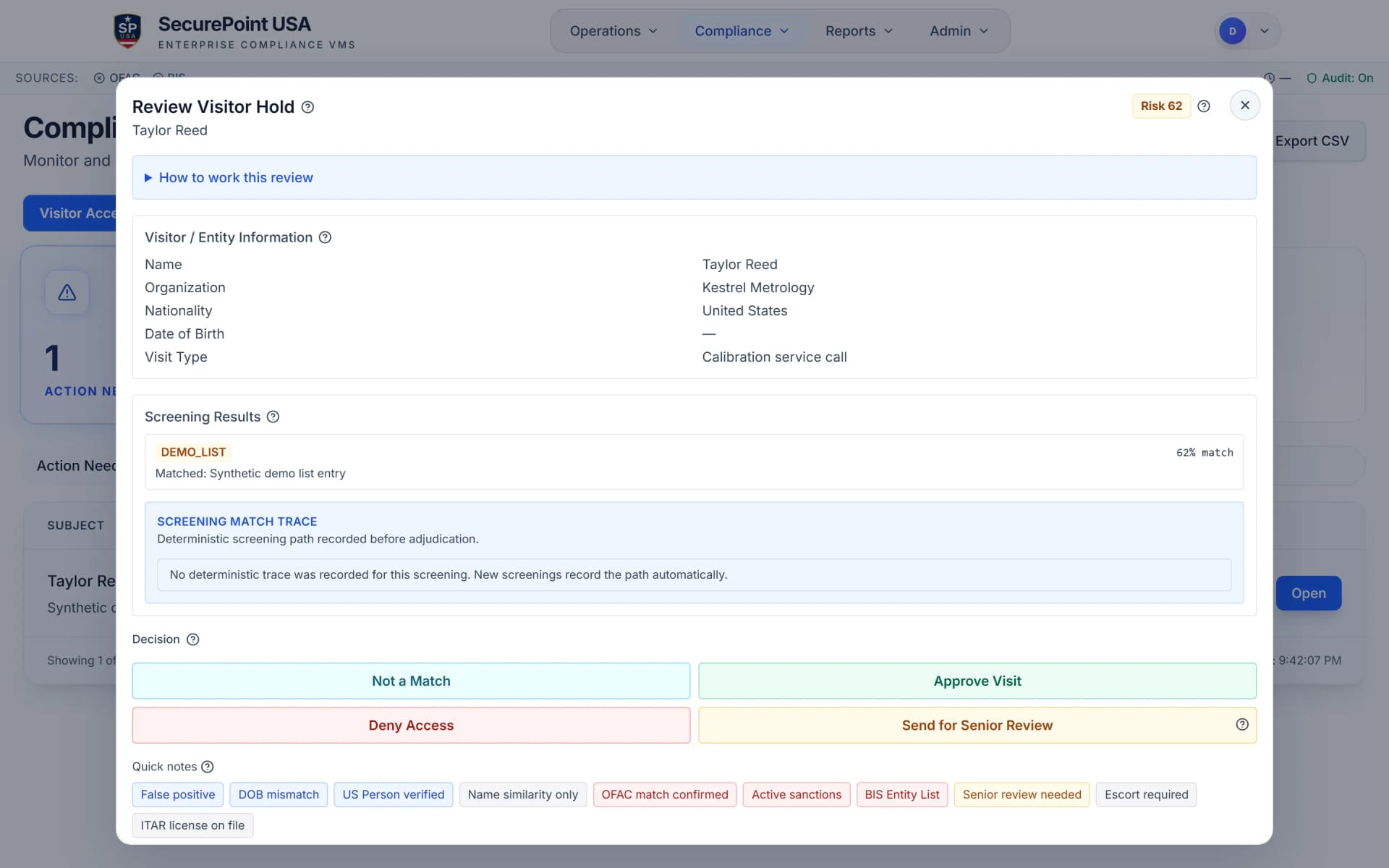
Pictured: a review screen for a held visitor, from a demo organization with fictional visitors.
- Named sanctions and watch lists
- OFAC, BIS, UN, UK, EU and more. Each list refreshes on its own schedule.
- No badge until the checks clear
- Pending reviews, missing NDAs and incomplete screening stop the print.
- Append-only audit trail
- SHA-256 hash-chained. Application users can't edit or delete it.
- 10-year decision records
- Screening and review records can't be deleted for 10 years.
- Unlimited visitor screenings
- Visitor plans are priced per site.
- Hosted in U.S. regions
- The application runs on Vercel and the database on Supabase, both in U.S. West regions.
One visit, start to finish.
A host invites a visitor, the kiosk checks them in, a possible match waits for a reviewer, and the decisions stay on record.
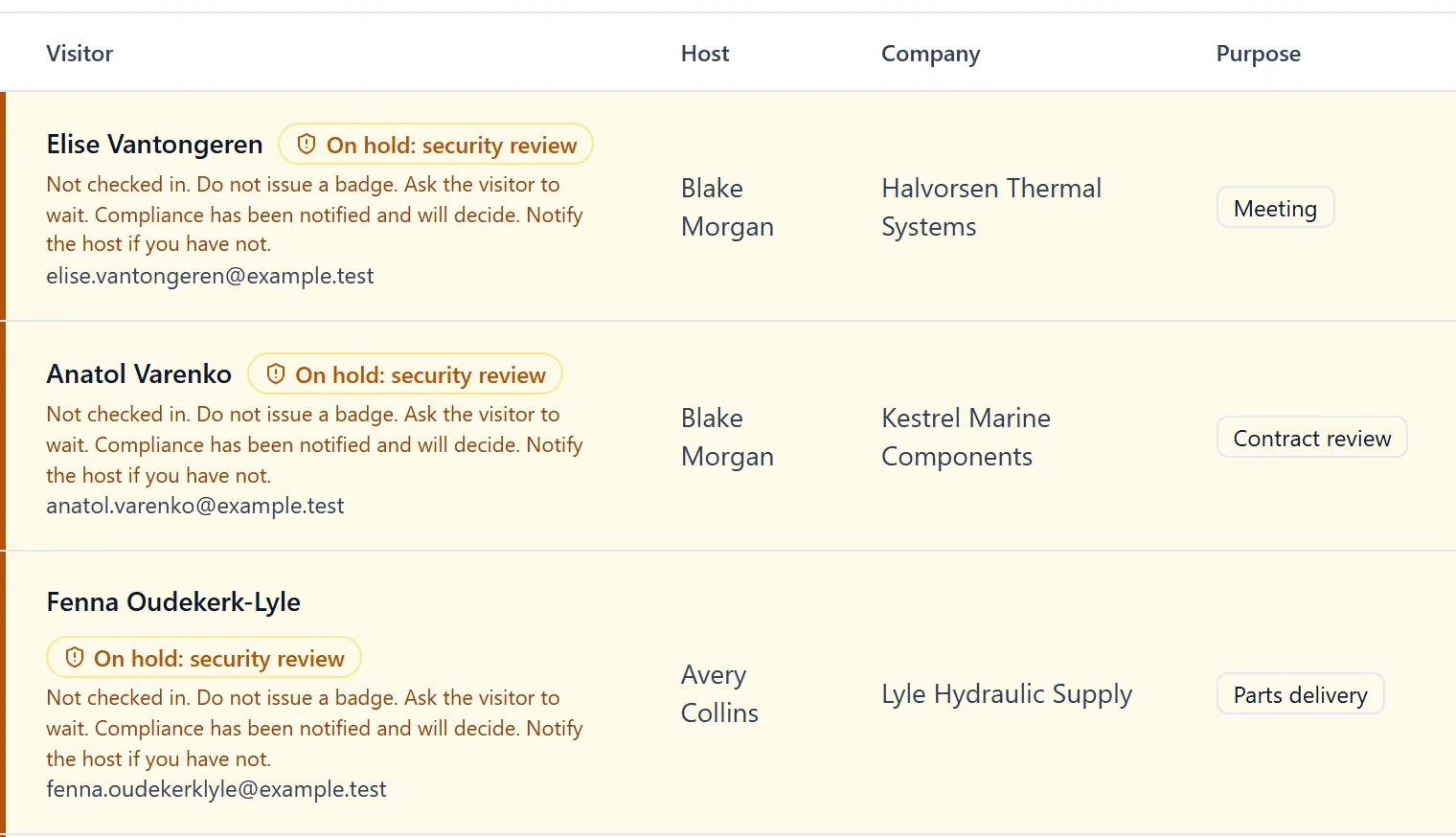
The front desk sees who is on site, and who is held.
The front desk dashboard shows who is on site, who is expected and who is held for review. Visitors check in at the kiosk by QR code, ID scan or by hand, or staff check them in at the desk.
The badge waits for the evidence.
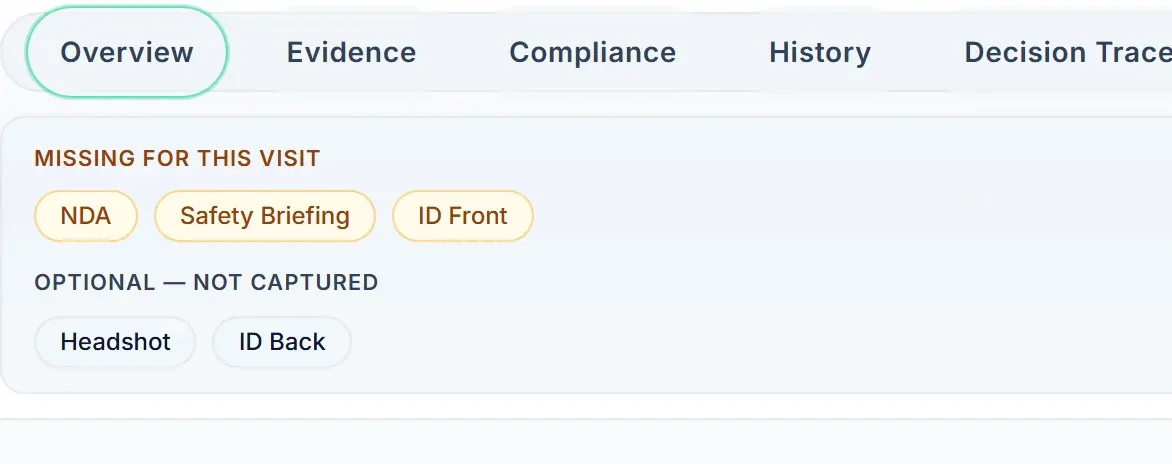
Each site's security profile sets what a visit needs: host approval, ID capture, an NDA or safety briefing, an escort. Until those are on the visit and screening has cleared, the badge does not print.
Only a staff role allowed to override can print past a missing step, and it takes a written reason. A required escort can't be skipped that way.
The decisions land in the audit log.
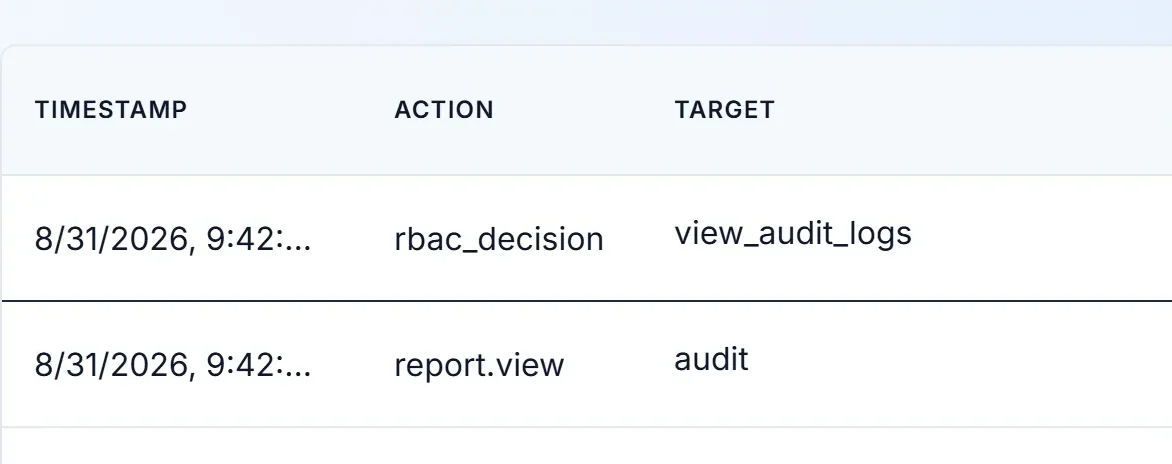
Check-ins, host approvals, screening decisions, badge prints and check-outs go to an append-only, hash-chained audit log that application users cannot edit or delete, with a verifier that checks the chain.
Export an evidence pack for the date range and sites an assessor asks about. It exports with SHA-256 checksums.
What's in the platform, and how it's sold.
The core modules come with every Visitor plan. What each plan includes is on the pricing page.
| Module | Availability | What it does |
|---|---|---|
| Kiosk and front desk | Core | Check-in by QR code, ID scan or by hand, at the kiosk or the desk, with host alerts by email, and by text on plans with SMS. |
| Host Hub | Core | Hosts invite their own visitors and follow each visit, signing in with a password or a work Microsoft account. |
| Sanctions screening | Core | Each visitor, and the company they list, is checked against named lists. A possible match holds the visit for a person. |
| Adjudication queue | Core | Possible matches wait in a review queue with SLA tracking, and every decision carries a reason. |
| Audit log | Core | An append-only, hash-chained audit log that application users cannot edit or delete, with a verifier that checks the chain. |
| Evidence packs | Add-on | Packs organized for CMMC Level 2, DFARS 252.204-7012 and ITAR/EAR reviews, exported with SHA-256 checksums. The CMMC Level 2 evidence pack is an add-on on every plan. |
| Workforce and vendor screening | Add-on | Re-screens employees, contractors and vendors on the interval you set. An add-on on Defense Front Desk, included in Enterprise Compliance. |
| Third-Party Integrity Monitor | Controlled pilot | Roster reviews against restricted-party lists, enforcement sources and news. Turned on per organization, not part of every plan. |
| Screening API | On approval | Screen names and companies from your own systems. SecurePoint turns it on for your organization and issues the keys. |
For your security review.
Each line says whether a control is built into the product, documented, or still planned. No control is independently audited yet.
| Area | Status | What it means |
|---|---|---|
| Sign-in and access | Built in | Microsoft Entra ID single sign-on on every plan, MFA enforced by organization policy, and role-based permissions. |
| Hosting and data | Built in | The application runs on Vercel and the database on Supabase, both in U.S. West regions. Each organization's data is separated by row-level security. |
| Audit trail | Built in | Append-only audit log, SHA-256 hash-chained, with an integrity check every day. |
| Record retention | Built in | Screening and review records can't be deleted for 10 years. |
| Subprocessors | Published | Named list with purposes. The AI providers that summarize screened names and read ID text at browser kiosks both run until an administrator turns them off. |
| Incident response | Documented | A written runbook with named roles. Breach notification terms are in the DPA. |
| SOC 2 Type II | Not certified | Controls are mapped to the Trust Services Criteria. The Q3 2027 target is not a commitment. |
| Penetration test | Planned | No third-party test has been performed yet. Internal security review is ongoing. |
The modules in detail
See it with a visit you run every week.
Bring a sample visit. We'll walk through check-in, a held match, the decision and the evidence pack.
Frequently asked questions
- Is visitor data separated between organizations?
- Yes. Each organization's data is separated by row-level security in the database, and the organization comes from trusted server-side context rather than anything the browser supplies.
- Can the audit trail be edited or deleted?
- Not by application users. It's an append-only, hash-chained audit log that application users cannot edit or delete, with a verifier that checks the chain. Screening and review records can't be deleted for 10 years.
- What happens if screening cannot complete?
- The visit holds rather than passes. A screen that cannot run, or a possible match that has not been decided, does not become an approval by default.
- Where is the data held?
- The application runs on Vercel and the database on Supabase, both in U.S. West regions, and each organization's data is separated by row-level security. AI providers and messaging services are named separately on the subprocessors page.
- Does SecurePoint make us compliant?
- No. SecurePoint supports your compliance program: it screens visitors, records the decisions and produces the evidence. It doesn't certify your program, and it doesn't file with any agency on your behalf.