
ITAR and EAR
Visitor management for ITAR and EAR facilities.
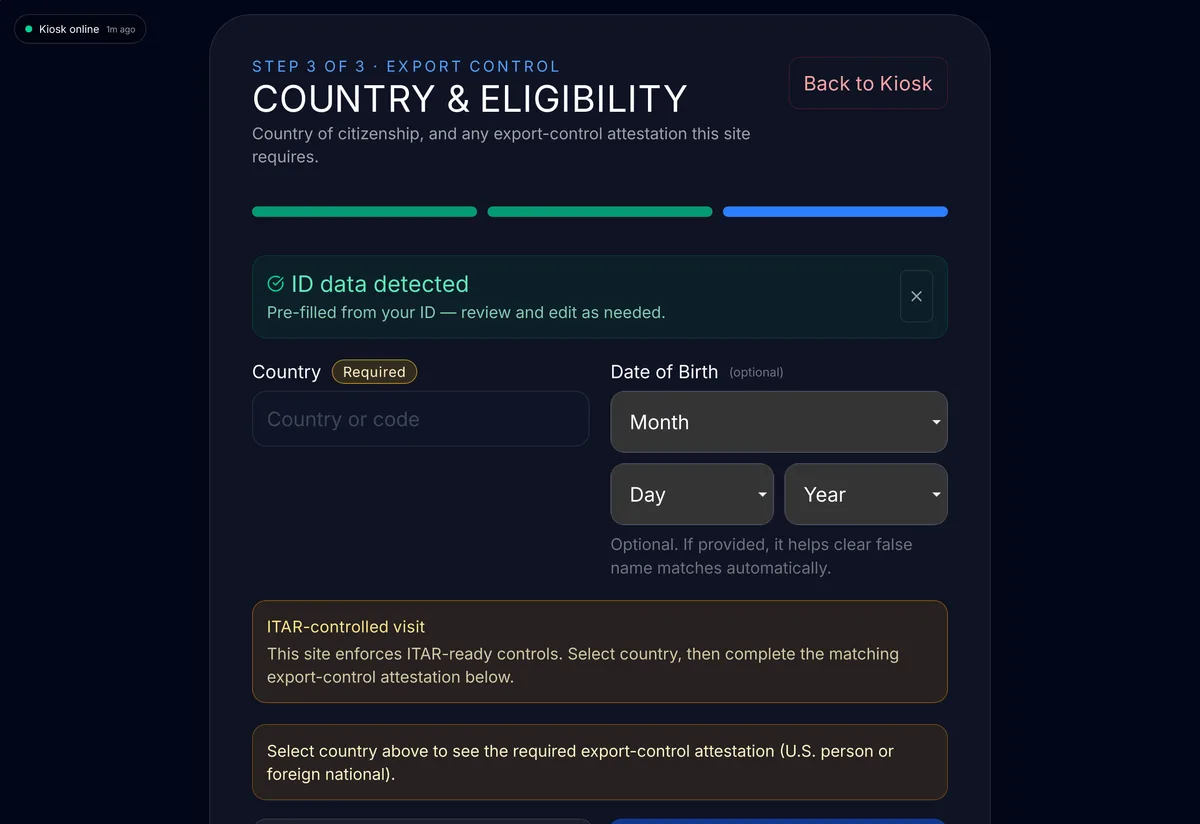
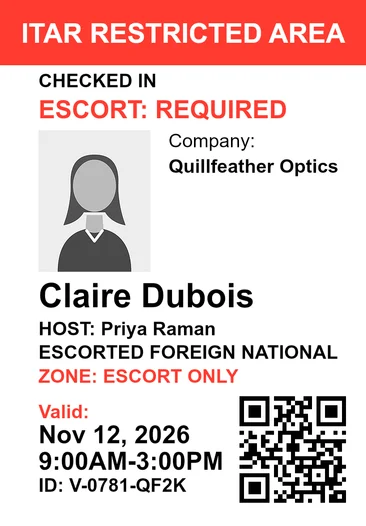
Visitors attest U.S.-person status at check-in. At an ITAR site, a foreign national needs an escort and host verification, and the desk can't admit them until an escort is assigned. The screening results, the escort and every decision are kept for your export-control review.
Pictured: the kiosk's export-control step at an ITAR-controlled site, and an ITAR badge for a foreign national, from a demo organization with fictional visitors.
- U.S.-person attestation
- Visitors attest their status at check-in where the site requires it.
- Escort before admission
- At an ITAR site, the desk can't admit a foreign national until an escort is assigned.
- Host verification at autonomous kiosks
- The host checks the ID and commits to the escort and to not sharing controlled technical data.
- §126.1 nationals held
- Nationals of ITAR §126.1 countries wait for compliance review.
- After-visit report
- At check-out, the host is asked whether any controlled technical data was shared.
- ITAR / EAR Export Pack
- Screening, decisions, list freshness, the audit trail and your configuration, with SHA-256 checksums.
ITAR follows the data, not the contract.
You don't need a federal contract to be in scope. If a prime sends you ITAR-controlled drawings or EAR-controlled technology, showing them to a foreign person, even inside your own building, can be an export that needs authorization. These are the agencies and parties behind the rules a visit touches.
- DDTC, State DepartmentAdministers the ITAR: defense articles, defense services and their technical data.
- BIS, Commerce DepartmentAdministers the EAR, including deemed exports of controlled technology, and keeps the Entity, Military End-User and Denied Persons lists.
- DCSA, Defense DepartmentOversees cleared facilities under the National Industrial Security Program. Classified visit requests stay in your existing process; SecurePoint doesn't connect to DISS.
- OFAC, Treasury DepartmentAdministers sanctions. Visitors are screened against the OFAC SDN and SSI lists alongside the BIS lists.
- Your prime or customerFlows contract requirements down to you, and may ask how you screen and escort visitors.
How a foreign national's visit runs.
Requirements are set per site. This is the flow at a site marked ITAR-controlled that runs autonomous kiosk check-in. Where a desk is staffed, the desk admits the visitor once an escort is assigned.
At an autonomous kiosk, the host verifies them in person.
A visitor who lists another country of citizenship acknowledges they're a foreign national, and the kiosk asks them to wait for their host. The host gets an email to come to the kiosk, and there confirms three things: they checked the visitor's nationality on the ID, they'll escort the visitor at all times, and they won't share export-controlled technical data without authorization. Then the badge prints.
When the visitor checks out, the host is asked for an after-visit report: whether any controlled technical data was shared, and a short summary. If the report is late, reminders follow.
Read the transcript
When the site requires it, a visitor who lists another country of citizenship acknowledges they're a foreign national, and that the visit may need an escort and more review.
The kiosk asks the visitor to wait for their host. The host gets an email asking them to come to the kiosk, check the visitor's photo ID, and print the badge. It also says the visit needs an escort.
At the kiosk, the host enters their name and confirms three things: they checked the visitor's nationality on their ID, they'll escort them at all times, and they won't share export-controlled technical data without authorization. Then the kiosk prints the badge.
When the visitor checks out, the host is asked for an after-visit report: whether any controlled technical data was shared, and a short summary. If it's late, reminders follow.
SecurePoint Visitor. Screen visitors at check-in, and keep the decisions on record.
Escorted, and on the record.
The desk can't admit a foreign national until an escort is assigned, and the escort's assignment, start and end are recorded against the visit. The ITAR badge template prints the escort requirement and an escort-only zone line.
Some visits wait for compliance review.
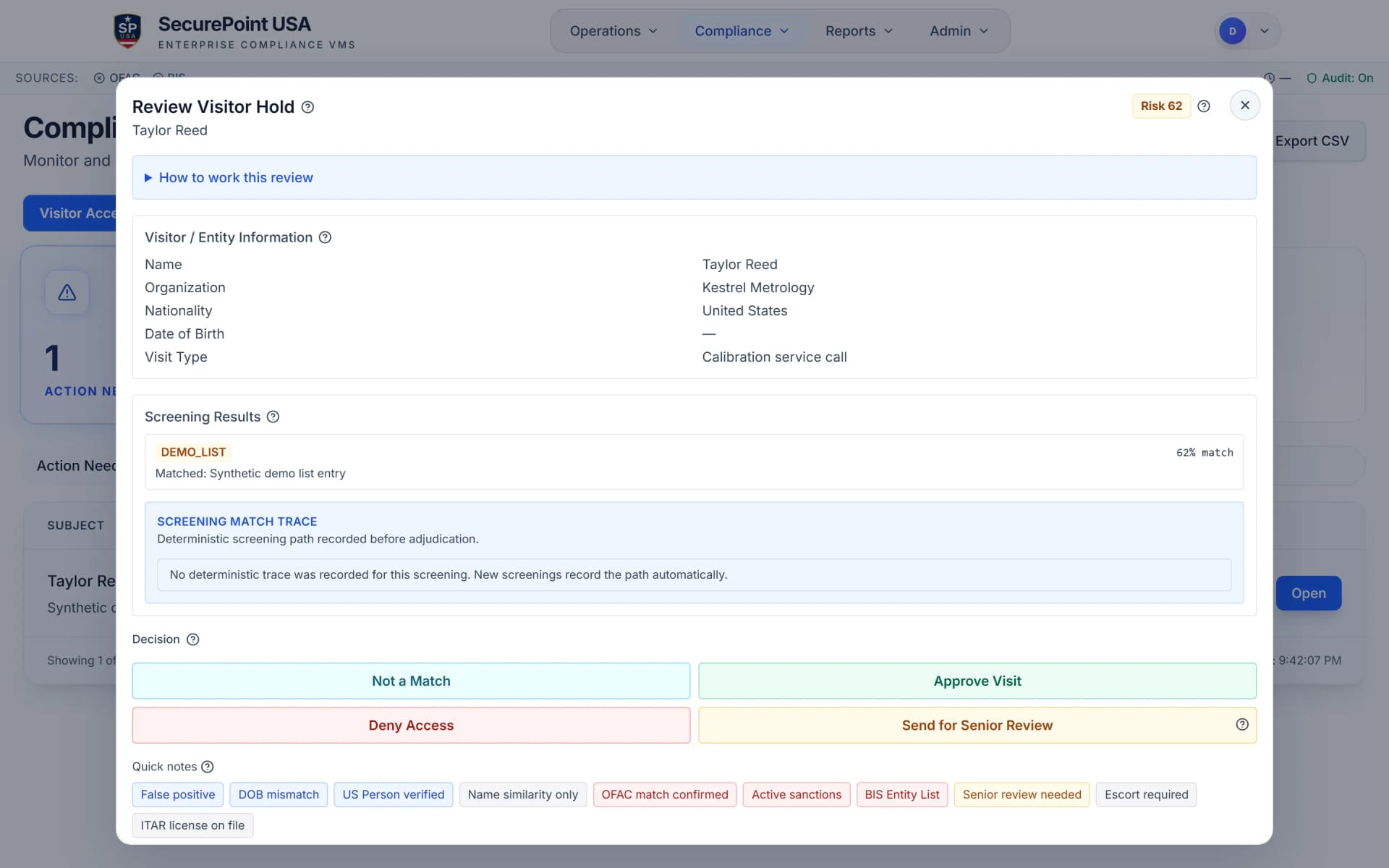
Nationals of ITAR §126.1 countries are held for compliance review, and so is any visitor whose name looks like a possible match on a restricted-party list. A reviewer compares the details, then records the decision and a reason: not a match, approve, deny, or send for senior review. No badge prints while the review is pending.
Screening against the ITAR Debarred List can be enabled for an organization.
The ITAR / EAR Export Pack.
When a prime, an export-control reviewer or your own auditor asks how visitors were handled, pick the ITAR / EAR Export Pack and the dates in the Evidence Center. It downloads as a ZIP whose manifest lists a SHA-256 checksum for each file.
| Part | In this pack | What it holds |
|---|---|---|
| Screening activity | Included | Each screening in the date range, with its result. |
| Review decisions | Included | Each decision on a possible match, with who made it and the reason. |
| List freshness | Included | Each screening list's freshness status and its last successful load, as of the export. |
| Audit trail | Included | The append-only, hash-chained audit records for the date range. |
| Configuration snapshot | Included | Your organization, sites, settings, screening configuration and user roles when the pack was built. |
| Escort and badge records | In the PE pack | Escort assignments and badge issuance are in the CMMC L2 PE Visitor Evidence pack. Export it for the same dates. |
Where SecurePoint stops.
SecurePoint records what happened at the visit. Export determinations stay with your program, and SecurePoint doesn't file with any agency on your behalf.
| Area | Status | What it means |
|---|---|---|
| Restricted-party screening | Built in | OFAC SDN and SSI, the BIS Entity and Military End-User lists, BIS Denied Persons, UN, UK, EU and more, when the visitor registers or at the kiosk for walk-ins. |
| ITAR Debarred List | By organization | Screening against the ITAR Debarred List can be enabled for an organization. |
| U.S.-person status | Attested | Visitors attest it at check-in. For a foreign national, the host checks nationality on the ID at the kiosk. |
| License and classification decisions | Not included | SecurePoint doesn't classify items or decide whether a release needs a license. That stays with your export compliance lead or counsel. |
| Classified visits | Not included | SecurePoint doesn't connect to DISS. Classified visit requests stay in your existing process. |
| Doors and access control | Not included | There is no door, turnstile or access-control-system integration. The badge shows the escort rule, and your procedures enforce it. |
Related reading
Bring a foreign-national visit you ran last quarter.
We'll check in a foreign national, run the host verification, assign the escort and export the ITAR / EAR Export Pack, so you can see the record your reviewer would get.
Questions about ITAR and EAR visitor controls
- We sell to a prime, not to the government. Does this apply to us?
- Often, yes. ITAR follows the technical data and defense articles you handle, not who signs your purchase order. If a prime sends you ITAR-controlled drawings, showing them to a foreign person, even inside your own building, can be an export that needs authorization, so the visitor rules on this page apply to your shop floor too. Confirm your obligations with your export compliance lead or counsel.
- What does SecurePoint do for ITAR and EAR?
- For visitor workflows: U.S.-person attestation at check-in, a required host and escort rules at ITAR sites, holds for nationals of ITAR §126.1 countries, restricted-party screening, and the ITAR / EAR Export Pack. Screening against the ITAR Debarred List can be enabled for an organization. Licensing decisions stay with your export compliance program.
- Can SecurePoint support EAR deemed export reviews?
- It records the visitor side. Under the EAR, releasing controlled technology to a foreign person in the United States is a deemed export to that person's country. SecurePoint records who the visitor is, their attested U.S.-person status, their host and escort, and, for a foreign national's visit, the host's after-visit report on whether any controlled technical data was shared. Whether a release needs a license is your export compliance team's call.
- How are escort rules set?
- Each site's security profile sets who needs an escort. At a site marked ITAR-controlled, a foreign national needs an escort and host verification, and the desk can't admit them until an escort is assigned. The ITAR badge template prints the escort requirement and an escort-only zone line. Escort assignment, start and end are recorded against the visit.
- What evidence is available for an export-control review?
- The ITAR / EAR Export Pack exports screening activity, review decisions, the freshness of each screening list, the audit trail and a snapshot of your configuration for the dates you pick, as a ZIP whose manifest lists a SHA-256 checksum for each file. Escort and badge records are in the CMMC L2 PE Visitor Evidence pack, which you can export for the same dates.
- Where does DCSA fit?
- If your facility holds a facility clearance, DCSA oversees your security program under the National Industrial Security Program. SecurePoint doesn't connect to DISS, and classified visit requests stay in your existing process. SecurePoint covers the unclassified visitor side: screening, escort rules, badges and the visit record. DDTC administers the ITAR, and BIS administers the EAR.
- Does this mean we turn away foreign nationals?
- No. Export controls restrict access to controlled technical data and defense articles, not visits by foreign nationals in general. SecurePoint applies the escort and review rules your site sets, and the access decision stays with your export compliance program.