
Compliance
Compliance workflows for regulated facilities.
SecurePoint screens every visitor, holds a possible match for a person, enforces each site's escort and badge rules, and keeps the record. Start with the rule your review is about: CMMC and DFARS, ITAR and EAR, or the 50 percent ownership rules.
Pictured: the kiosk running its security checks, and a visitor badge printed by SecurePoint, from a demo organization with fictional visitors.
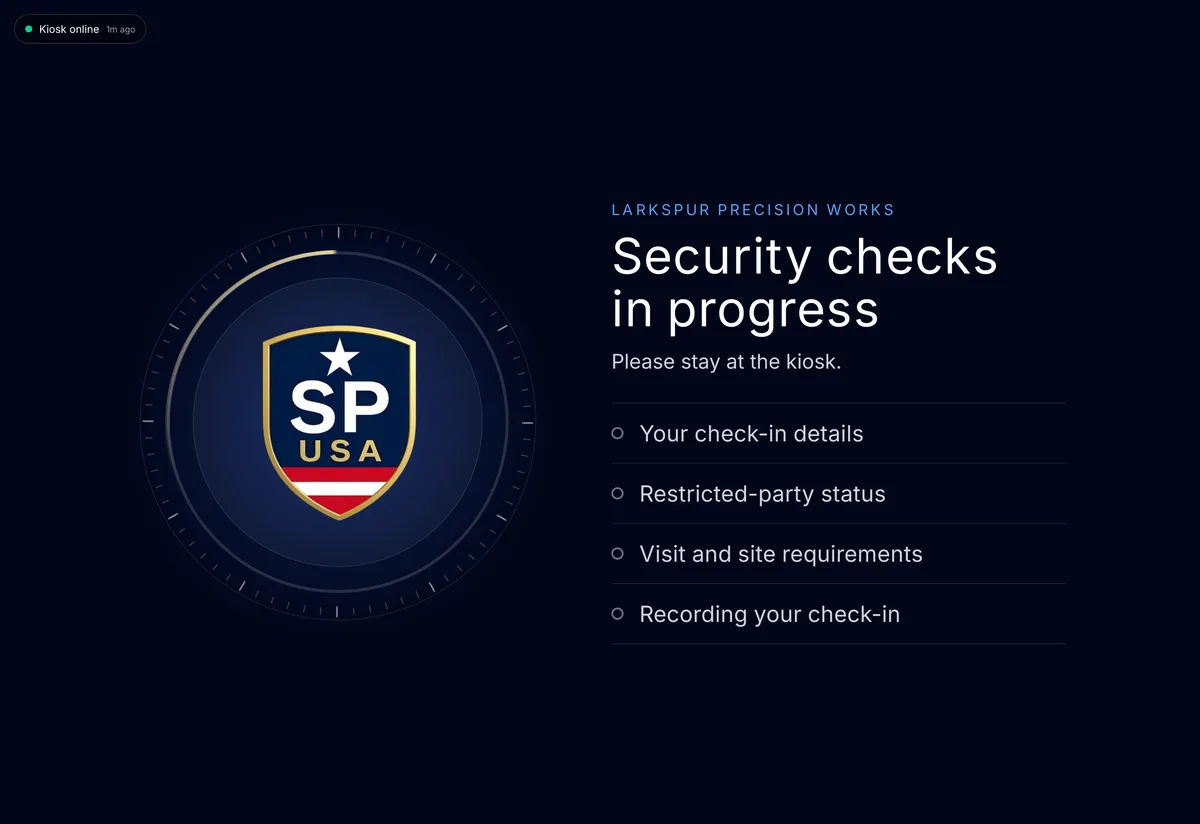
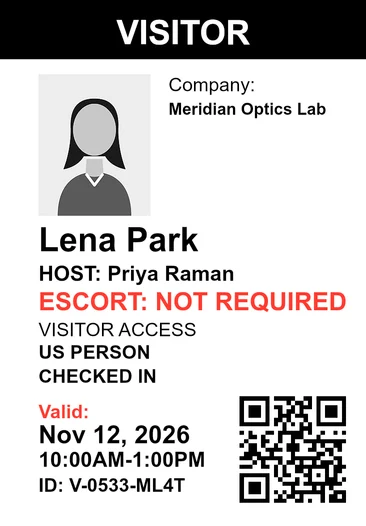
- Direct evidence for PE.L2-3.10.3 and 3.10.4
- Escort assignments and the physical-access log, kept with each visit.
- Escorts before admission
- At an ITAR site, the desk can't admit a foreign national until an escort is assigned.
- BIS lists screened by name
- Ownership is not traced for visitors or their employers.
- Append-only audit trail
- SHA-256 hash-chained. Application users can't edit or delete it.
- 10-year decision records
- Screening and review records can't be deleted for 10 years.
- Hosted in U.S. regions
- Vercel and Supabase, both in U.S. West regions.
What each page covers.
Pick the rule your review is about. Each page says what the rule asks of a visitor program, what SecurePoint records, and where it stops.
| Page | SecurePoint | What the page covers |
|---|---|---|
| CMMC and DFARSCMMC 2.0 Level 2, DFARS 252.204-7012 | Records evidence | How visitor records line up with the six Physical Protection requirements, what an assessor receives in an evidence pack, and the facts a security review asks for. |
| ITAR and EARForeign-national visits and controlled technical data | Enforced at check-in | U.S.-person attestation, escorts and host verification for foreign nationals at ITAR sites, holds for nationals of ITAR §126.1 countries, and the ITAR / EAR Export Pack, for primes and for the suppliers who handle their technical data. |
| BIS 50 percentOFAC and BIS ownership rules | Name screening | Visitors and the companies they list are screened by name against the BIS lists, and a possible match waits for a person. Ownership is not traced for visitors or their employers, and the BIS Affiliates Rule calculation is not part of screening yet. |
NIST SP 800-171, Physical Protection
CMMC Physical Protection, in short.
CMMC Level 2 assesses your organization, not a vendor, against six Physical Protection requirements. Visitor records are direct evidence for two, support two more, cover one in part, and do not address the sixth.
| Requirement | Evidence | What SecurePoint records |
|---|---|---|
| PE.L2-3.10.3 and 3.10.4Escort and monitor visitors. Keep audit logs of physical access. | Direct evidence | Escort assignment is recorded against the visit, with start and end, and check-ins, approvals, badge prints and check-outs land in the append-only audit trail. |
| PE.L2-3.10.1 and 3.10.5Limit physical access. Control access devices. | Supporting | Host approval, ID capture and badge issuance show who was authorized and which badge they carried. Your facility enforces the boundary, collects badges and controls its own credentials. |
| PE.L2-3.10.2Protect and monitor the physical facility. | Partial | Shows who is on site and flags overdue check-outs. There is no CCTV or access-control integration and no location tracking. |
| PE.L2-3.10.6Safeguard CUI at alternate work sites. | Not claimed | Concerns alternate work sites, which a visitor record does not cover. |
The same two checks under every rule.
Whichever review you face, a possible match waits for a person, and no badge prints until the visit has what the site requires.
A possible match waits for a person.
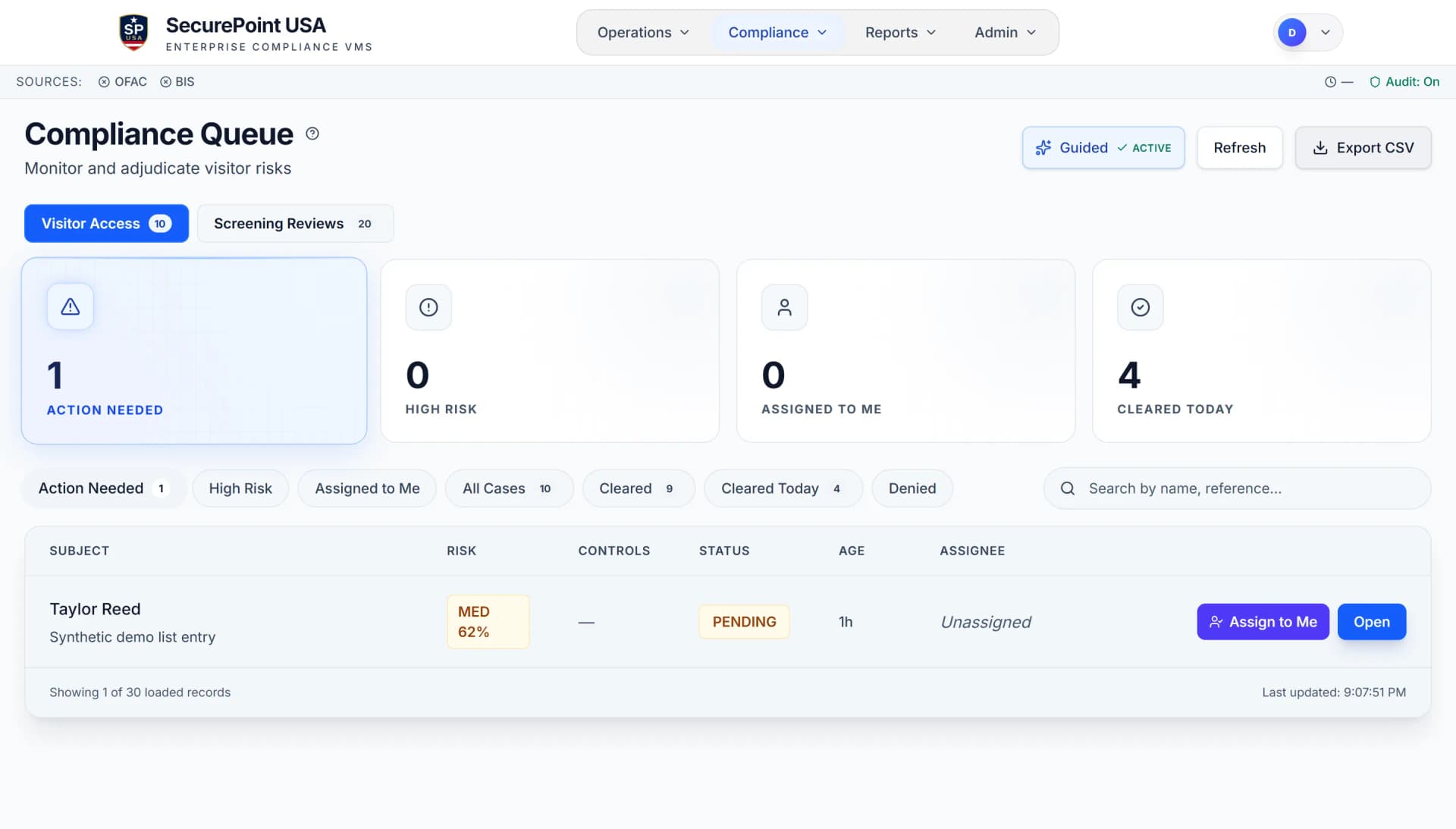
A visitor whose name looks like a possible match on a sanctions or restricted-party list is held in the adjudication queue until a reviewer decides. The queue shows how long each review has waited, and the decision, who made it and the reason go on the record.
Name matching is fuzzy matching, not AI. By default an AI provider named on the Subprocessors page also writes a summary of each screened name for the reviewer; it doesn't make the decision.
No badge until the checks clear.
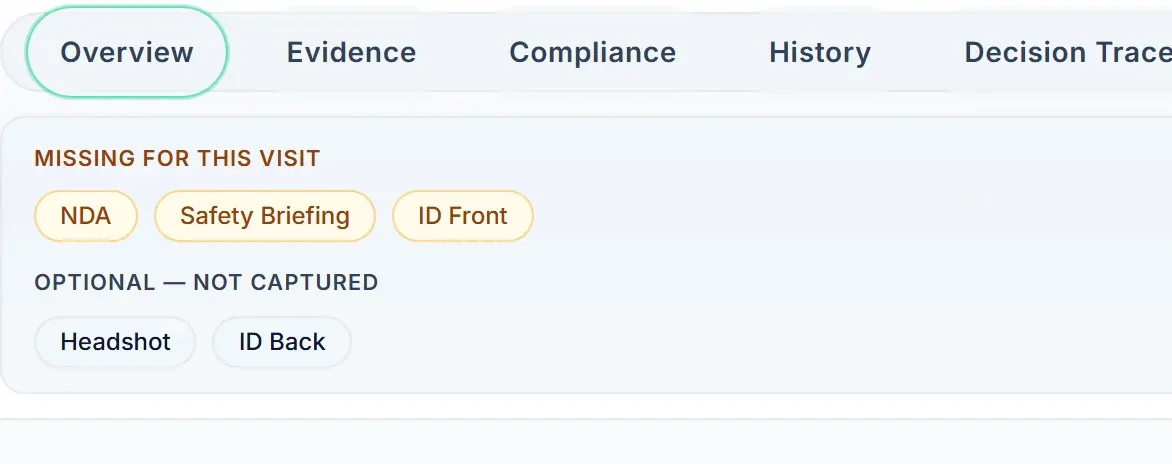
One server-side check stops every badge print while a review is pending or denied, a required NDA, safety briefing or ID capture is missing, or screening couldn't finish.
Only a staff role allowed to override can print past a missing step, and it takes a written reason. A required escort can't be skipped that way.
Hosting, records and the audit trail.
Each line says whether a control is built in, documented, or still planned. SecurePoint does not claim CMMC certification or FedRAMP authorization.
| Area | Status | What it means |
|---|---|---|
| Hosting and data | Built in | The application runs on Vercel and the database on Supabase, both in U.S. West regions. Each organization's data is separated by row-level security. |
| Audit trail | Built in | Append-only audit log, SHA-256 hash-chained, with an integrity check every day. |
| Record retention | Built in | Screening and review records can't be deleted for 10 years. |
| Subprocessors | Published | Named list with purposes. The AI providers that summarize screened names and read ID text at browser kiosks both run until an administrator turns them off. |
| SOC 2 Type II | Not certified | Controls are mapped to the Trust Services Criteria. The Q3 2027 target is not a commitment. |
| Penetration test | Planned | No third-party test has been performed yet. Internal security review is ongoing. |
Ownership rule guides
Bring the review you're preparing for.
We'll check in a visitor, hold a possible match, assign an escort and export the evidence pack, so you can see the record your reviewer would get.
Common questions
- Does SecurePoint make us compliant?
- No. Compliance is a program you run, and a CMMC assessment is made against your organization, not a vendor. SecurePoint is one control inside that program: it screens visitors, enforces the escort and badge rules each site sets, and keeps the records a reviewer asks for. It doesn't certify anything, and it doesn't file with any agency on your behalf.
- Which page do I need?
- Start with the rule in your contract or your security plan. If you handle CUI for a defense contract, start with CMMC and DFARS. If your site holds ITAR technical data or EAR-controlled technology, start with ITAR and EAR. If a prime or a customer asked how you screen visitors and the companies they work for, start with BIS 50 percent.
- Does SecurePoint decide whether we need an export license?
- No. SecurePoint records who visited, what screening found and who decided. License and classification decisions stay with your export compliance lead or counsel, and SecurePoint doesn't file anything with an agency for you.
- Where is our data hosted?
- The application runs on Vercel and the database on Supabase, both in U.S. West regions, and each organization's data is separated by row-level security. AI match summaries, on by default, use a provider listed on the Subprocessors page.