SecurePoint USA
Security Center
How SecurePoint protects visitor personal data, ID images, screening and review records, and audit logs, and the documents to check it. Built for defense, aerospace, and regulated facilities.
Last reviewed: September 1, 2026
- Tenant isolation in the database
- Row-level security scopes tenant data to its organization.
- Append-only audit log
- Hash-chained, with a verifier that checks the chain. Application users can't edit or delete it.
- MFA by organization policy
- SecurePoint's own super-admin access always requires it.
- Encrypted in transit and at rest
- TLS 1.2 or later, and provider-managed AES-256 at rest.
- Hosted in U.S. West regions
- The application on Vercel and the database on Supabase.
- 10-year decision records
- Screening and review records can't be deleted for 10 years.
Certifications and compliance program.
| Framework | Status | What we provide today |
|---|---|---|
| SOC 2 Type II | Not certified. Target Q3 2027 | Controls mapped to the Trust Services Criteria. Auditor selection in progress; scope, contracting, and the observation period are still being set, so the target date is not a commitment. |
| ISO/IEC 27001 | Control-informed; no audit planned | Designed with ISO/IEC 27001 control domains in mind and used as a security-program rubric. We are not pursuing ISO/IEC 27001 audit certification at this time. |
| NIST SP 800-171 / CMMC 2.0 L2 | Aligned to NIST SP 800-171; no SPRS score submitted | Controls are mapped to the applicable CMMC Level 2 and NIST SP 800-171 requirements within its defined environment. No C3PAO certification is claimed. Under the current Phase I framework, Level 2 may be satisfied through self-assessment where designated by the applicable solicitation or contract. |
| FedRAMP | Not claimed | No FedRAMP Ready, Authorized, or Certified status is claimed. |
| Penetration testing | Planned | Formal third-party penetration testing is planned; internal security review is ongoing. Contact us for current timelines. |
How we support your security review
- We will sign a mutual NDA to share detailed security documentation.
- We complete vendor security questionnaires (SIG, CAIQ, and custom formats).
- Downloadable security overview, control matrix, evidence map, and subprocessor list below.
- Architecture review calls with our engineering team on request.
Company and legal
- Legal entity: SecurePoint USA LLC, a Washington limited liability company.
- Registered address: 522 W Riverside Ave, Ste N, Spokane, WA 99201.
- Jurisdiction: U.S.-based company; the application and its database are hosted in U.S. regions.
- Procurement details: W-9 and government procurement identifiers are provided during procurement via security@securepointusa.com.
Company details
- Legal name
- SecurePoint USA LLC
- Unique Entity ID (UEI)
- Z899Z49EMA65
- CAGE code
- 24JR2
SAM.gov registration: UEI Z899Z49EMA65, CAGE 24JR2 (verified October 2026). SAM.gov registration is not a certification or government endorsement.
Architecture and trust boundaries.
Client browser → Vercel edge and API routes → Supabase Postgres with row-level security. Private storage buckets for IDs, photos, evidence, and exports.
Client ↔ edge
TLS 1.2+ enforced, secure cookies.
Edge ↔ database
Authenticated service connections, RLS enforced.
Edge ↔ storage
Private buckets, signed URL access only.
Multi-tenant data isolation.
All tenant data is strictly scoped by organization_id columns. Row-level security (RLS) policies enforce access control at the database engine level, ensuring data isolation even if application logic fails.
What this means
- Cross-tenant reads are blocked by database policy.
- Cross-tenant writes are blocked by database policy.
- Policy violations act as a fail-safe against application bugs.
Support access
Super-admin support actions are audit-logged and restricted. We do not access customer data without explicit authorization or incident context.
Identity and access management.
Authentication
Supabase Auth. An organization can require MFA for its members and enforce it at sign-in; members who sign in with Microsoft Entra ID single sign-on use their identity provider's MFA. SecurePoint's own super-administrators need a fresh second factor before any permanent deletion. SSO is available with Microsoft Entra ID (Azure AD).
Authorization
Role-based access control (RBAC) enforced through user_roles tables and RLS policies.
Session security
- Cookie protection: HttpOnly, Secure, SameSite enforced.
- Session timeout: configurable per organization.
- Account lockout: enforced policy against brute force attempts.
Data protection and encryption.
Encryption
TLS 1.2+ in transit. Provider-managed AES-256 at rest (Supabase).
Signed URLs
Short-lived, time-bounded signed URLs for all asset access. No public buckets.
Retention
Screening and review records can't be deleted for 10 years. Audit logs are append-only and kept for 10 years (3,650 days). Image and document retention is configurable per organization.
Audit logging and append-only protection.
Application users can't edit or delete an audit record.
SecurePoint keeps an append-only, hash-chained audit log that application users cannot edit or delete, with a verifier that checks the chain. Database triggers block UPDATE and DELETE on the audit_logs table to keep the chain of custody.
Every audit insert is linked into a SHA-256 hash chain seeded per organization, and the verifier checks the chain every day.
One scheduled database job is the exception: after 180 days, it replaces the IP address on each audit record with a salted hash. The IP address is not part of the hash chain, so the chain still verifies.
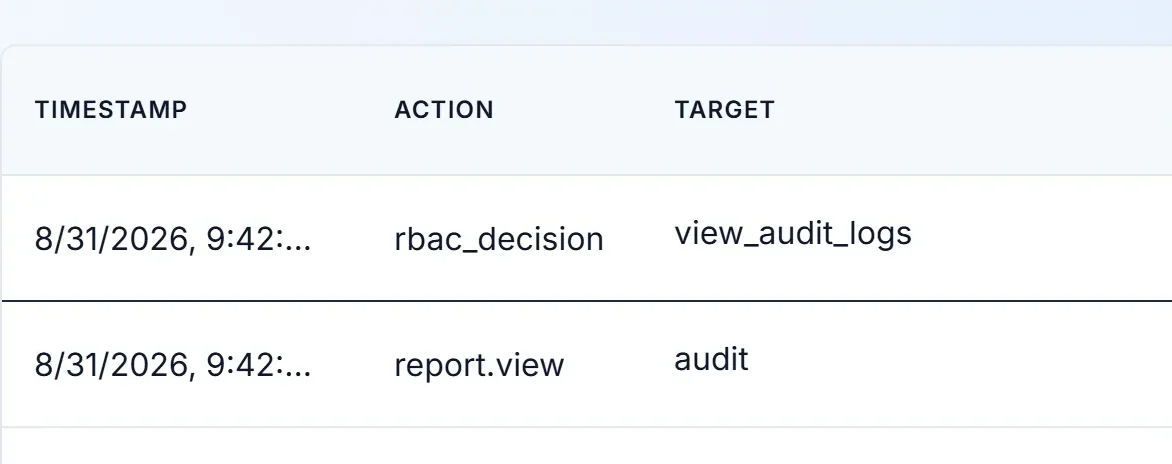
What we log
- Auth events (login, logout, lockout)
- Visitor operations (check-in and check-out, status change)
- Compliance decisions (adjudication, screening hits)
- System events (configuration changes, exports)
Correction model
The application can't edit or delete audit records, and database triggers enforce it. Corrections are recorded as new events.
CMMC, EAR, and DFARS control alignment.
SecurePoint Visitor implements the applicable CMMC Level 2 and NIST SP 800-171 controls within its environment, and carries the physical-security, visitor-control, and access-governance workflows used by defense, aerospace, and export-controlled facilities. It has not undergone a C3PAO assessment, and no product on its own makes a customer compliant.
CMMC Level 2 control mapping
| Control | Feature mapping |
|---|---|
| PE.L2-3.10.3 | Escort visitors and monitor visitor activity: escort assignment and recording, and host verification |
| PE.L2-3.10.4 | Maintain audit logs of physical access: who entered, when, under whose escort, with what screening result |
| PE.L2-3.10.1 | Limit physical access to authorized individuals: badge issuance gated on screening result and access eligibility |
| PE.L2-3.10.5 | Control and manage physical access devices: badge issuance, reprint, and status tracking |
| AU.L2-3.3.1 | Create and retain audit logs: append-only logging with database-level UPDATE/DELETE protection and a SHA-256 hash chain |
| AU.L2-3.3.2 | Uniquely trace actions to individual users: actor, action, target, metadata, timestamp on every event |
| AC.L2-3.1.1 | Limit system access to authorized users: RBAC with organization-scoped roles, enforced by row-level security |
| AC.L2-3.1.2 | Limit access to permitted transactions and functions: granular server-side permission model |
| AC.L2-3.1.8 | Limit unsuccessful logon attempts: account lockout, configurable per organization |
| AC.L2-3.1.11 | Terminate a session after a defined condition: session timeout, configurable per organization |
| IA.L2-3.5.3 | Multifactor authentication for privileged and non-privileged accounts: MFA required by organization policy and enforced at sign-in, or by the identity provider for Microsoft Entra ID sign-ins, and a fresh second factor is always required before a SecurePoint super-administrator permanently deletes data |
| SC.L2-3.13.1 | Protect communications at system boundaries: TLS 1.2+ enforced (1.0/1.1 refused), HSTS preload, rate limiting, Content-Security-Policy |
| SC.L2-3.13.16 | Protect confidentiality of data at rest: AES-256 provider-managed encryption, private buckets, short-lived signed URLs. Not FIPS-validated. |
| EAR / deemed export | Visitor identity, nationality or U.S.-person attestations where configured, host verification, and auditable records that can support a customer technology-control plan. SecurePoint does not determine license requirements. |
| DFARS support | Organization-scoped access, MFA/RBAC controls, audit history, and visitor-access evidence that may support procedures associated with DFARS safeguarding obligations. SecurePoint is not itself a DFARS certification and does not replace customer CUI-system requirements. |
Export-control workflow support
- Sanctions and restricted-party screening for visitor access (OFAC and BIS enforced by default; additional sources such as DDTC by configuration)
- U.S. person and foreign-person attestation workflow support where configured
- Audited decisions for access to export-controlled areas, technology, or facilities
- Visitor identity, host verification, badge status, and evidence records that may support a customer's EAR deemed-export and DFARS safeguarding procedures
CMMC Level 2: Physical Protection Evidence Planning
A planning checklist for CMMC Level 2 Physical Protection (PE) visitor evidence, with a suggested pack structure. Agree on scope with your assessor.
API and operational security.
Schema validation
Strict Zod validation on all API inputs to prevent injection and malformed data.
Rate limiting
Protection on sensitive endpoints (auth, check-in, messages) to prevent abuse and DoS.
Monitoring
Error events and performance metrics are logged with organization context. Alerts configured for security anomalies.
Backups and disaster recovery
Continuous backups with point-in-time recovery. Documented business continuity and incident response plans.
Vulnerability disclosure
Report a security issue to security@securepointusa.com. Scope, what we ask of researchers, and what we commit to are published at /security/disclosure; the contact is machine-readable at /.well-known/security.txt.
Downloads and evidence.
Separate PDFs to scope a security review: an overview, a control matrix, an evidence map, and the subprocessor list.
- Security Overview(PDF download)
Software controls and their limits.
- Security Control Matrix(PDF download)
Controls by review area, with evidence to request.
- Security Evidence Map(PDF download)
Review questions, evidence, and each item's limits.
- Subprocessors(PDF download)
Providers, roles, and data categories.
IT and compliance questions.
- How do you prevent one customer from seeing another customer's data?
- Row Level Security policies enforce tenant isolation in the database, scoped by organization_id. Any request authenticated as a user is held to that user's organization there, whatever the application code does. Work that runs outside a user session, such as scheduled jobs and support tooling, uses service credentials that stay on the server and never reach the browser; those paths carry their own permission checks, and privileged actions are written to the append-only audit log.
- Do you have SOC 2 Type II?
- No. Controls are mapped to the Trust Services Criteria. Auditor selection is in progress, and the Q3 2027 target is not a commitment. Under NDA we provide the control matrix, evidence map, and completed vendor questionnaires.
- Do you have ISO 27001 certification?
- No, and we are not pursuing one. We use the ISO/IEC 27001 control domains as a rubric for our own program, and will walk your team through the documented policies and controls during due diligence.
- How does SecurePoint support EAR and DFARS programs?
- SecurePoint can support the visitor identity, host verification, screening, access-decision, badge, and audit workflows used by organizations protecting export-controlled technology or covered defense information. The customer remains responsible for determining applicable EAR licenses, technology-control requirements, DFARS clauses, CUI scope, and system-security obligations.
- Will you sign an NDA for security due diligence?
- Yes. We routinely sign mutual NDAs to share detailed security documentation, questionnaire responses, and architecture details. Send your NDA or request ours at security@securepointusa.com.
- What is your legal business entity?
- SecurePoint USA is operated by SecurePoint USA LLC, a Washington limited liability company. Registered address: 522 W Riverside Ave, Ste N, Spokane, WA 99201. W-9 and procurement identifiers are provided during procurement. Contact security@securepointusa.com.
- Where is our data stored?
- The application runs on Vercel and the database on Supabase, both in U.S. West regions. AI match summaries, on by default, and messaging use the providers named on the subprocessors page.
- How do you secure IDs and documents?
- Private storage buckets, server-side signed URLs, configurable retention, and auditability for access. Direct public access is blocked.
- Do you support Single Sign-On (SSO)?
- Yes. Microsoft Entra ID (Azure AD) single sign-on is included on every plan. Contact us for provider-specific integration details and setup guidance.
- How should GCC High users set up Microsoft Authenticator for CMMC MFA?
- SecurePoint MFA accepts standard authenticator app codes. If your Microsoft Entra tenant is GCC High, start Microsoft Authenticator enrollment from https://aka.ms/MySecurityInfo-us so the flow uses Azure Government instead of the commercial Microsoft security-info page. For normal SecurePoint email/password login, Microsoft Authenticator can also scan the SecurePoint QR code as a standard TOTP app without Microsoft sign-in. Entra push MFA and number matching are different and require Microsoft/Entra SSO. CMMC Level 2 maps MFA to NIST SP 800-171 IA.L2-3.5.3; keep enrollment and enforcement evidence for required users.
- Can we get a copy of your penetration test report?
- Formal penetration testing is planned. Contact security@securepointusa.com for our current security packet, vendor questionnaire responses, and assessment timelines.
- How do you handle vulnerability patching?
- Dependency updates are reviewed regularly and security patches are prioritized. Automated vulnerability scanning is planned for continuous monitoring. Critical vulnerabilities are prioritized for expedited remediation.
- What happens to our data if we cancel?
- Data is retained per your contract terms, and customer data can be exported on termination. Screening and review records can't be deleted for 10 years, and the audit log is append-only, so those records are kept for that period. Other data is handled under the data retention policy.
- What is on your security roadmap?
- Expanded automated testing coverage, scenario-specific incident response playbooks on top of the written runbook we work from today, and SOC 2 Type II certification. Distributed rate limiting is already in production (Redis-backed).
Talk to the security team.
For questionnaires, due diligence, and IT review scheduling.