
Aerospace and defense
Aerospace and defense visitor management for ITAR and EAR sites.
Each visitor is screened against restricted-party lists before a badge prints. At an ITAR site a foreign national needs an escort and host verification, and after the visit the host is asked whether they shared controlled technical data. Every decision lands in a record your FSO can export.
Pictured: the kiosk and a badge printed by SecurePoint, from a demo organization with fictional visitors.
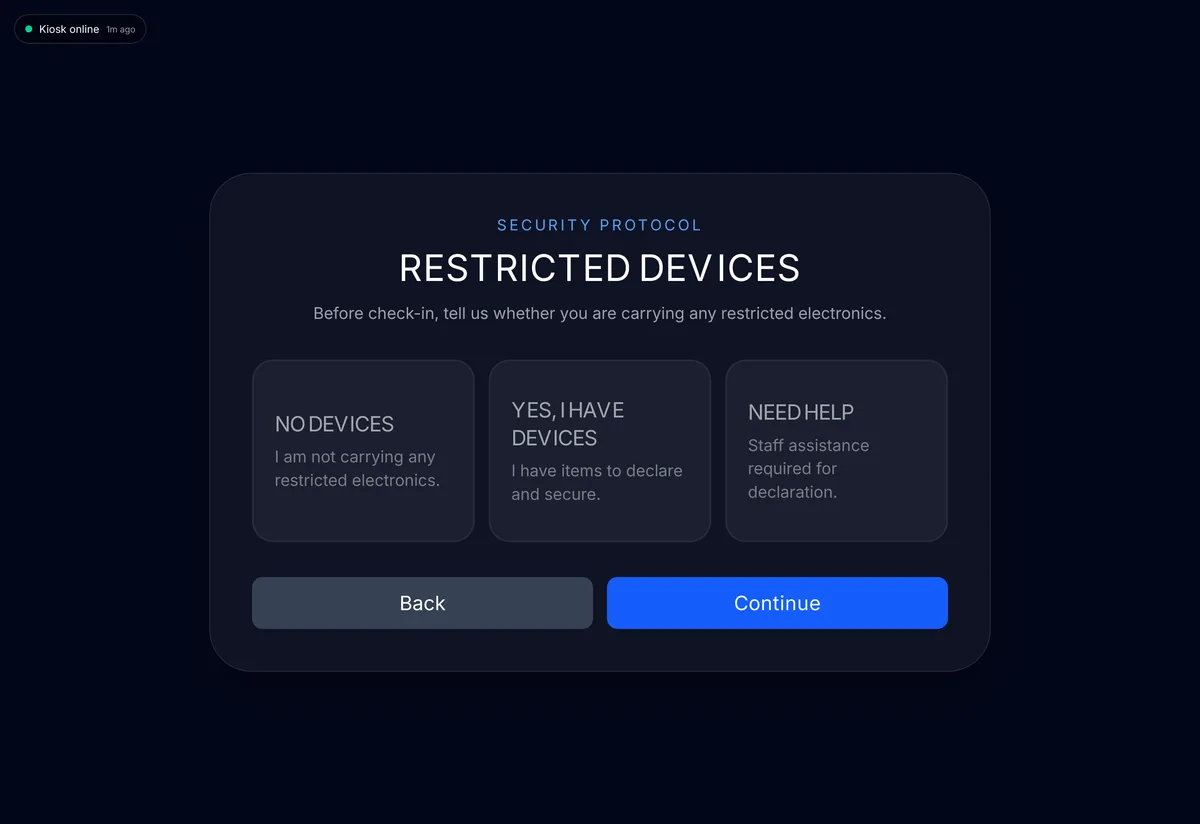
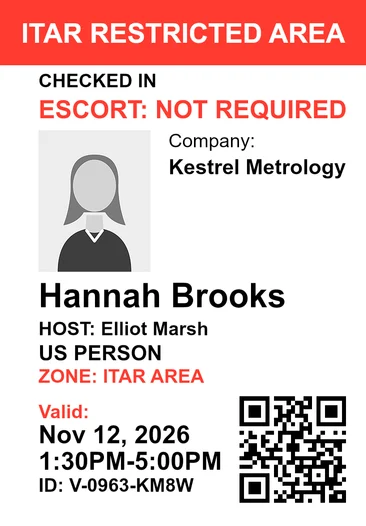
- Screened before the badge prints
- Against OFAC, BIS, UN, UK, EU and more, when a visitor registers or at the kiosk.
- Escorts at ITAR sites
- A foreign national can't be admitted until an escort is assigned.
- Host verification at the kiosk
- The host confirms nationality on the ID and agrees to escort the visitor.
- After-visit reports
- Hosts record whether they shared controlled technology or technical data.
- Append-only audit trail
- Hash-chained, with a verifier. Application users can't edit or delete it.
- Evidence packs
- Templates for ITAR/EAR, CMMC Level 2 and DFARS reviews, with SHA-256 checksums.
Export control
What happens when a foreign national arrives.
Visitors attest U.S.-person status at check-in, and the site's security profile decides what follows.
Escort and host verification for foreign nationals.
At an ITAR site, a foreign national needs an escort and host verification, and the desk can't admit them until an escort is assigned. Nationals of ITAR §126.1 countries are held for compliance review.
The ITAR badge template prints the escort requirement and an escort-only zone line.
Requirements are set per site. The drawing shows the default posture for a site marked ITAR-controlled.
Watch the flow at the kiosk.
The host gets an email to come to the kiosk. There they confirm that they checked the visitor's nationality on the ID, that they will escort the visitor at all times, and that they won't share export-controlled technical data without authorization. Then the badge prints.
Read the transcript
When the site requires it, a visitor who lists another country of citizenship acknowledges they're a foreign national, and that the visit may need an escort and more review.
The kiosk asks the visitor to wait for their host. The host gets an email asking them to come to the kiosk, check the visitor's photo ID, and print the badge. It also says the visit needs an escort.
At the kiosk, the host enters their name and confirms three things: they checked the visitor's nationality on their ID, they'll escort them at all times, and they won't share export-controlled technical data without authorization. Then the kiosk prints the badge.
When the visitor checks out, the host is asked for an after-visit report: whether any controlled technical data was shared, and a short summary. If it's late, reminders follow.
SecurePoint Visitor. Screen visitors at check-in, and keep the decisions on record.
After the visit, the host reports.
A visit to a controlled area isn't finished at check-out. The host says what was shared, and the answer goes on the same record.
Controlled technical data, on the record.
When the visitor checks out, the host is asked for an after-visit report: whether they shared controlled technology or technical data, and what, and whether pricing came up. If they shared controlled technology, an alert goes to the contacts your organization sets.
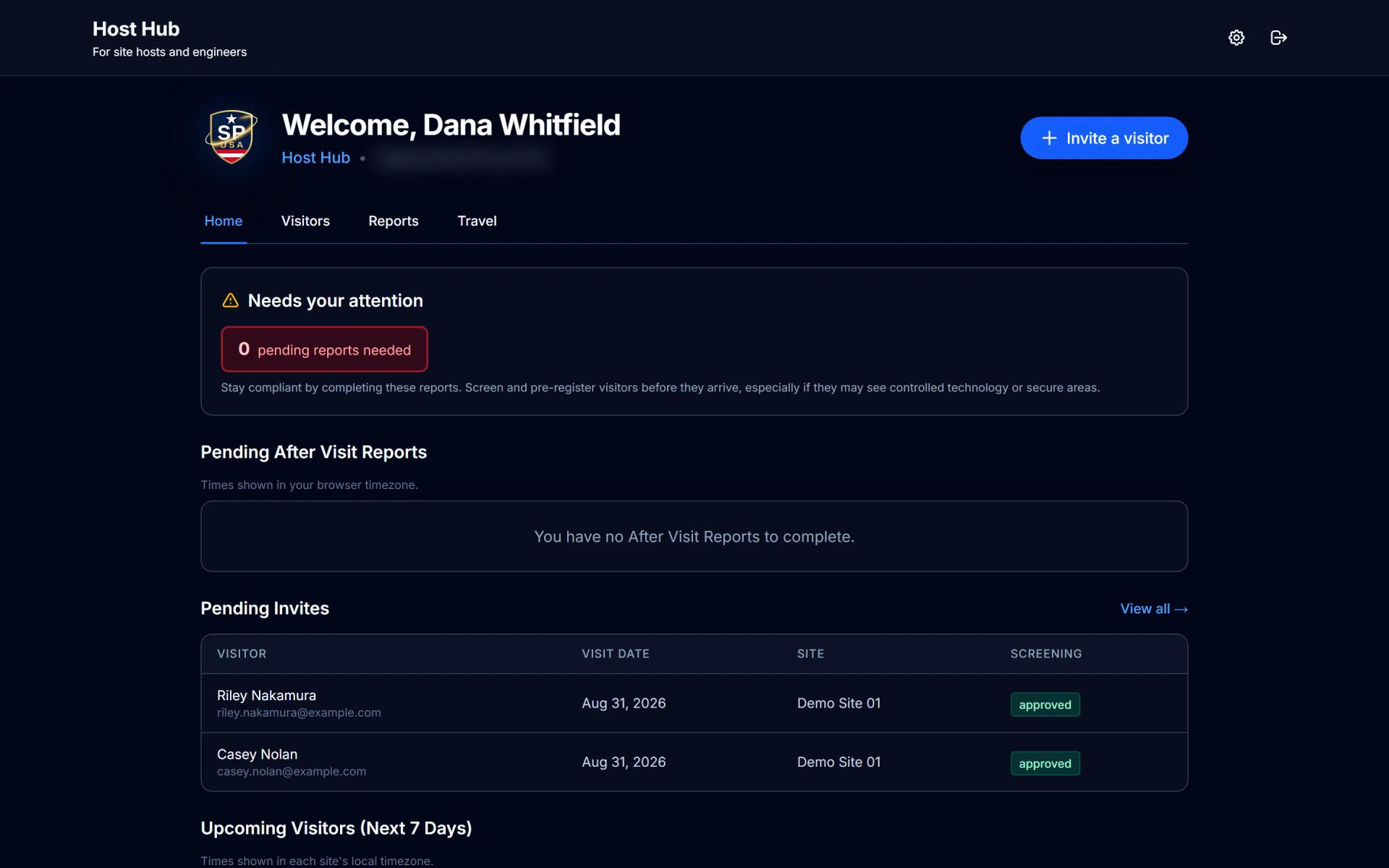
Pending reports wait in each host's Host Hub.
Screened against named sanctions and watch lists.
Screening runs when a visitor registers, or at the kiosk for walk-ins. Each list refreshes on its own schedule. Name matching is fuzzy matching, not AI, and a possible match waits for a person.
- OFAC Specially Designated Nationals ListU.S. Treasury
- OFAC Sectoral Sanctions Identifications ListU.S. Treasury
- BIS Entity List and Military End-User ListU.S. Commerce
- BIS Denied Persons ListU.S. Commerce
- Section 1260H Chinese military companiesU.S. Defense
- UFLPA Entity ListU.S. Homeland Security
- UN Security Council Consolidated ListUnited Nations
- UK Sanctions ListUK FCDO
- EU financial sanctionsEuropean Union
- French asset-freeze registerFrench Treasury
- World Bank and IADB debarmentsDevelopment banks
- INTERPOL Red Notices and FBI Most WantedLaw enforcement
What SecurePoint records, and what stays with you.
Your Technology Control Plan sets the rules. SecurePoint carries them out at the door and keeps the record that they ran.
| Area | Status | What it means |
|---|---|---|
| Restricted-party screening | Built in | Named lists, at registration or at the kiosk. A possible match holds the visit for a reviewer, who records the decision and a reason. |
| Escort and host verification | Built in | At an ITAR site the desk can't admit a foreign national until an escort is assigned. |
| After-visit reports | Built in | Hosts record whether they shared controlled technology or technical data, and what. |
| Audit trail | Built in | An append-only, hash-chained audit log that application users cannot edit or delete, with a verifier that checks the chain. |
| Record retention | Built in | Screening and review records can't be deleted for 10 years. |
| OwnershipOFAC 50 percent rule | Not traced | Ownership is not traced for visitors or their employers. |
| License determinations | Stays with you | Screening says whether a party matches a list. Whether a release needs a license is for your export-control officer or counsel. |
| Filings | Stays with you | SecurePoint does not file with DDTC, BIS or OFAC on your behalf. |
Related reading
Bring a foreign-national visit you ran last month.
We'll check a foreign national in at a demo ITAR site, assign the escort, hold a possible match, and export the evidence pack your FSO would hand over.
Frequently asked questions
- Does SecurePoint make our facility ITAR compliant?
- No. ITAR compliance is a program your organization runs, and the obligation stays with you. SecurePoint is a control inside that program: it screens visitors, captures purpose and host, records escort requirements, and keeps an audit trail of who entered and who permitted them.
- What is a deemed export in a visitor context?
- Releasing controlled technical data to a foreign person inside the United States can constitute an export under the ITAR and the EAR, including through a facility visit that gives access to controlled areas or data. Whether a specific release requires authorization is a determination for your export-control officer or counsel.
- Can a visitor system replace our Technology Control Plan?
- No. The Technology Control Plan is the document that defines your rules. A visitor system is one of the controls that carries those rules out at the door and records that they were applied. The plan stays yours to write, maintain and defend.
- What gets recorded for a visit to a controlled area?
- The visitor and their host, the stated purpose, the site, the escort requirement, the screening outcome, any adjudication decision with the reviewer who made it, badge issuance, and check-out. Those go to an append-only audit trail and export as an evidence pack.
- Does screening tell us whether a visitor needs a license?
- No. Screening tells you whether a party matches a restricted-party list and routes possible matches to a documented human review. License determinations belong with your export-control officer or trade counsel.