BIS 50 percent rule
Ownership screening and the BIS 50 percent rule.
For visitors, the short answer: ownership is not traced for visitors or their employers. Visitors, and the companies they list, are screened by name against the BIS Entity List, Military End-User List and Denied Persons List, and a possible match waits for a person. OFAC 50% ownership lookups on companies you look up are in beta, by request.
BIS Affiliates Rule: stayed by BIS, with resumption scheduled for January 11, 2027 absent further BIS action. Status and citations are below.
OFAC 50% Ownership Review Beta: access by request.
- Screened by name
- Visitors and the companies they list, when they register or at the kiosk.
- Held for a person
- A strong possible match blocks check-in pending review. A weaker one can hold it.
- No ownership tracing for visitors
- Ownership is not traced for visitors or their employers.
- OFAC 50% lookups in beta
- For companies you look up, by request, with the ownership chain documented.
- Affiliates Rule not calculated
- Screening does not calculate the BIS Affiliates Rule yet.
- Saved and exportable
- Each ownership lookup is saved and exports as a PDF or JSON evidence pack.
What SecurePoint checks today.
Three things are easy to mix up: a name match against a BIS list, an ownership lookup, and the BIS Affiliates Rule. Here is where each one stands.
| Check | Status | What it means |
|---|---|---|
| BIS list screeningEntity List, Military End-User (MEU) List, Denied Persons List | Built in | Visitors, and the companies they list, are screened by name when they register or at the kiosk, alongside the sanctions lists SecurePoint holds. A strong possible match is blocked pending review, and a weaker one can be held for documented human review. A reviewer confirms or rules out the match, and a denial is a separate recorded decision. |
| Ownership tracing for visitorsVisitors and their employers | Not included | Ownership is not traced for visitors or their employers. A visitor's company is screened by its name only. |
| OFAC 50% in screeningWhen the party screened is a company | Shadow by default | When a company is the party being screened, the OFAC 50% ownership check runs in shadow mode by default: its result is recorded and does not change the decision. |
| OFAC 50% Ownership ReviewBeta, access by request | Beta | Traces a company’s owners through the ownership records SecurePoint holds and adds up the share held by OFAC blocked persons, with the chain documented. It runs on companies you look up, not on visitors at check-in. Entity List and MEU owners are not counted toward the percentage. |
| BIS Affiliates RuleEntity List and MEU ownership of 50 percent or more | Not calculated | The Affiliates Rule calculation is not part of screening yet. SecurePoint does not flag an unlisted company because Entity List or MEU parties own 50 percent or more of it, so ownership diligence for that rule stays with your team. Nothing starts blocking automatically when a scheduled date arrives. |
When a name matches a BIS list.
A match is a question about identity, not a finding. A person answers it, and the answer goes on the record.
A reviewer decides, with a reason.
The reviewer sees what matched and how closely, compares it with what they know about the visitor, and records the decision and a reason: not a match, approve the visit, deny access, or send it for senior review. A denial is a separate, recorded compliance decision.
Name matching is fuzzy matching, not AI.
When the visitor's company is on the Entity List.
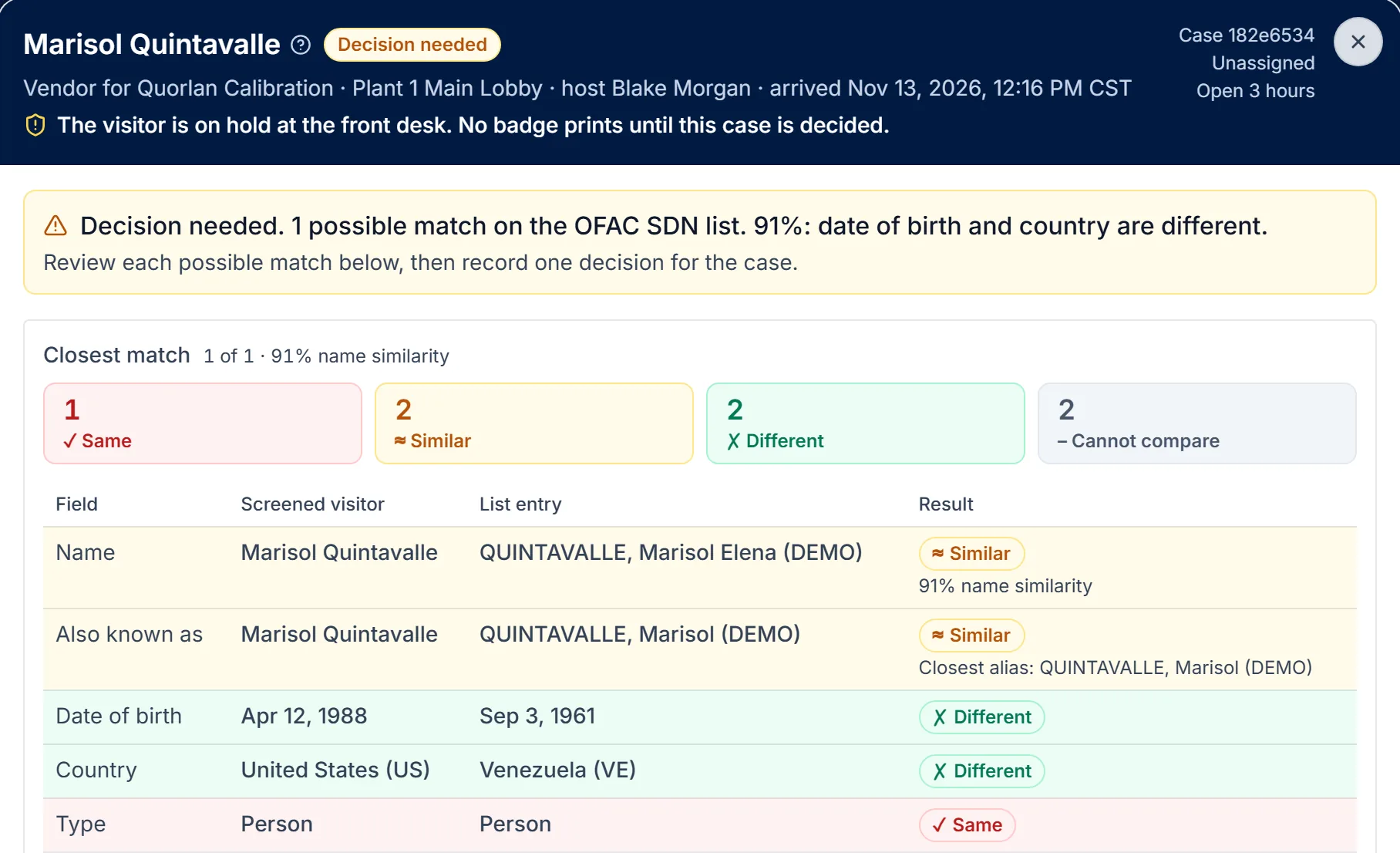
At check-in, SecurePoint screens the visitor and the company they list. When the company's name matches an Entity List listing, the visit is held before any badge, and the reviewer sees which list matched and that it was the company. That is a name match on the company, not an ownership finding. The video shows how a reviewer reads a possible match. A company case reads the same way, without a date of birth.
Read the transcript
A case opens when a visitor's name is similar to a name on a screening list. This video shows how to read one.
Step 1. Start at the top. The header shows who the visitor is, who they came to see, and where. It also tells you the visitor is on hold.
Step 2. Read the summary line. It tells you how many possible matches there are, on which lists, and which is closest.
Step 3. Check the closest match. The visitor's details sit beside the list entry's, one row per detail.
Read each row. Here the names are similar and the country is the same.
The date of birth is different. That is often the clearest sign this is a different person.
Some details cannot be compared, because one side does not have them. The ID document row is always yours to check against the visitor's document.
Step 4. Under the table, check which list this is, the entry ID, and the list version that was used.
Step 5. Look at every other possible match before you decide.
If a word is new to you, the question mark beside it explains it.
The similarity percent puts the matches in order. It is not a decision. You decide.
Step 6. When you have looked at every possible match, move to the decision column on the right.
A company case reads the same way. There is no date of birth, so compare the company's records with the list entry.
What the BIS 50 percent rule would require.
The BIS Affiliates Rule would extend Entity List and Military End-User List restrictions to a company that listed parties own 50 percent or more of, directly or indirectly and in aggregate, even when the company itself is not on a list. Ownership would have to be traced through subsidiaries and holding companies, and re-checked as it changes.
| Item | Status | Detail |
|---|---|---|
| BIS Affiliates RuleRule status: suspended, scheduled to take effect January 11, 2027 | Suspended | The BIS Affiliates Rule is suspended through January 10, 2027 and is scheduled to take effect January 11, 2027 absent further BIS action (BIS final rule, FR 2025-19846, extended by FR 2026-22793, staying the interim final rule at 90 FR 47201). While the stay holds it is not operative under the EAR. Status last verified against the Federal Register on November 7, 2026. Verify current status at bis.gov before relying on this page. |
| OFAC 50% Rule and EAR dutiesThey apply regardless of the stay | In force | A stay does not make ownership diligence optional. OFAC’s 50% Rule is in force today. The EAR’s General Prohibition 10, which bars proceeding with a transaction when you know or have reason to know a violation has occurred or is about to occur, and its Know Your Customer red-flag duties apply now, independent of the Affiliates Rule. |
| What SecurePoint does with a BIS matchThe same on every date | Built in | SecurePoint screens names against the BIS Entity List, MEU List and Denied Persons List on every date. A strong possible match is blocked pending review, and a weaker one can be held for documented human review. A reviewer then confirms or rules out the match, and a denial is a separate recorded compliance decision. It does not yet calculate Affiliates Rule ownership, and it does not start blocking automatically when a scheduled date arrives. |
Guides and tools
Request the Ownership Review Beta.
OFAC 50% ownership lookups with the chain shown and timestamped evidence packs. We review each request and send an invitation once it is approved. BIS resumption is scheduled for January 11, 2027 absent further BIS action. Our lookup does not calculate the Affiliates Rule yet.
Frequently asked questions
- What is the BIS 50 percent rule?
- It extends Entity List restrictions to entities that listed parties own in aggregate at or above fifty percent, even when the entity itself is not named on a list. Verify the current status, scope and effective date against bis.doc.gov before relying on any summary, including this one.
- Why is name-only screening not enough?
- Because an unlisted subsidiary of a listed parent will not match by name. Resolving ownership is what surfaces it. It is also why a consolidated screening list is a screening aid rather than a complete answer on restricted parties.
- Does SecurePoint block a visit on a BIS list match?
- It depends on the match. A strong possible match against the BIS Entity List, Military End-User (MEU) List or Denied Persons List blocks check-in pending review, and a weaker one can hold check-in for review instead. Neither means the visitor is the listed party: a reviewer confirms or rules out the identity match, and a denial is a separate compliance decision recorded with the reviewer. No ownership calculation decides a visit: ownership is not traced for visitors or their employers, and the Affiliates Rule ownership calculation is not part of screening yet.
- How is aggregate ownership resolved?
- In the Ownership Review beta, ownership chains are traced through the ownership records SecurePoint has loaded from public sources such as OpenSanctions and Wikidata, and the share held by OFAC blocked persons is added up with the chain documented alongside the result. Entity List and MEU owners are not counted toward that percentage. Coverage depends on what those records hold for a given entity: a company missing from them comes back unresolved, and a clean result is not proof of clean ownership.
- What is in an ownership evidence pack?
- A pack is generated only from an ownership lookup that SecurePoint ran and saved for your organization, as a PDF or JSON file. It records when it was generated, the depth and threshold the lookup used, the ownership chain and listed owners it found, and the aggregate percentage and threshold outcome where the lookup established them, with data freshness timestamps where they were recorded. When ownership could not be established, the pack says so rather than showing zero percent. It documents what was checked; it is not a legal determination.
- Does SecurePoint tell us whether we need a license?
- No. License determinations depend on the item, the technology, the destination and the end use. Screening tells you that a party matches and routes it to a reviewer. The determination belongs with your export-control officer or trade counsel.