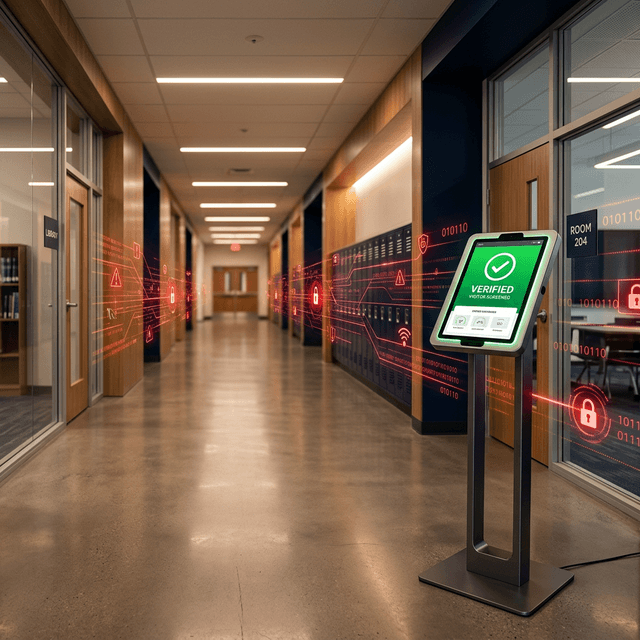
"Small organizations handle our biggest responsibilities. But while we've been focused on physical locks and gates, a different kind of intruder has found a back window."
In March 2026, leak-site trackers recorded a claim by the Nightspire ransomware group against a U.S. youth mentoring nonprofit. The claim listed student lists, background-check records, and internal documents among the alleged files. That is a threat-actor claim, not an organization-confirmed dump, and it is not a SecurePoint customer incident.
This isn't an isolated incident. We are witnessing a calculated pivot by cyber-cartels. While they still chase industrial giants like JBS Brazil (recently hit by CoinbaseCartel with 3TB exfiltrated), they have identified a path of even less resistance: Youth organizations and the Education sector.
The New Pattern
If a youth mentoring organization can be named on a leak site, what does that say about a school district still keeping screening files in spreadsheets? Treat actor claims as claims until the organization confirms them.
The Education Security Crisis
Schools and youth organizations are uniquely vulnerable for a simple, uncomfortable reason: They handle the most sensitive category of data (children's PII) with arguably the lowest relative security infrastructure of any sector.
Sensitive Data Gravity
Background check records, residency documents, and health information are high-value targets for identity theft that can go undetected for decades.
Unscreened Tuition Payors
As seen in the IMG Academy settlement, accepting tuition from sanctioned individuals exposes schools to millions in fines and massive data liability.
Fragmented Infrastructure
Records are often scattered across siloed departmental databases, making consistent encryption and access control nearly impossible.
Append-Only Audit Trails
Legacy systems lack tamper-proof logs, making it impossible to prove who accessed what data during a regulatory audit or post-breach investigation.
Beyond the Bitcoin: The Real Cost of a Breach
When a school is hit, the ransom demand is often the cheapest part of the ordeal. According to IBM’s latest data, the average cost of a breach in the public sector has soared past $4.5 million. For education leaders, the breakdown is even more painful:
- Regulatory Penalties: FERPA findings can put federal funding at risk, and state-level privacy lawsuits can strain district finances.
- Litigation Exposure: When parents learn that background check records were stored in unencrypted silos, class-action lawsuits are inevitable.
- Trust Erosion: Reputation takes years to build and seconds to dump on a leak site. Once the "safe space" label is lost, recruitment and retention suffer.
Strategic Resilience Checklist
Sanctions Screening at Check-In
Stop relying on "historical" checks. Screen every visitor against OFAC and other sanctions lists before a badge prints. Sex offender registry checks require a separate provider.
Encrypted, Append-Only Audit Trails
Transition away from shared databases. Move to encrypted, append-only logs that record every visitor and every screening decision.
Continuous Monitoring & Re-screening
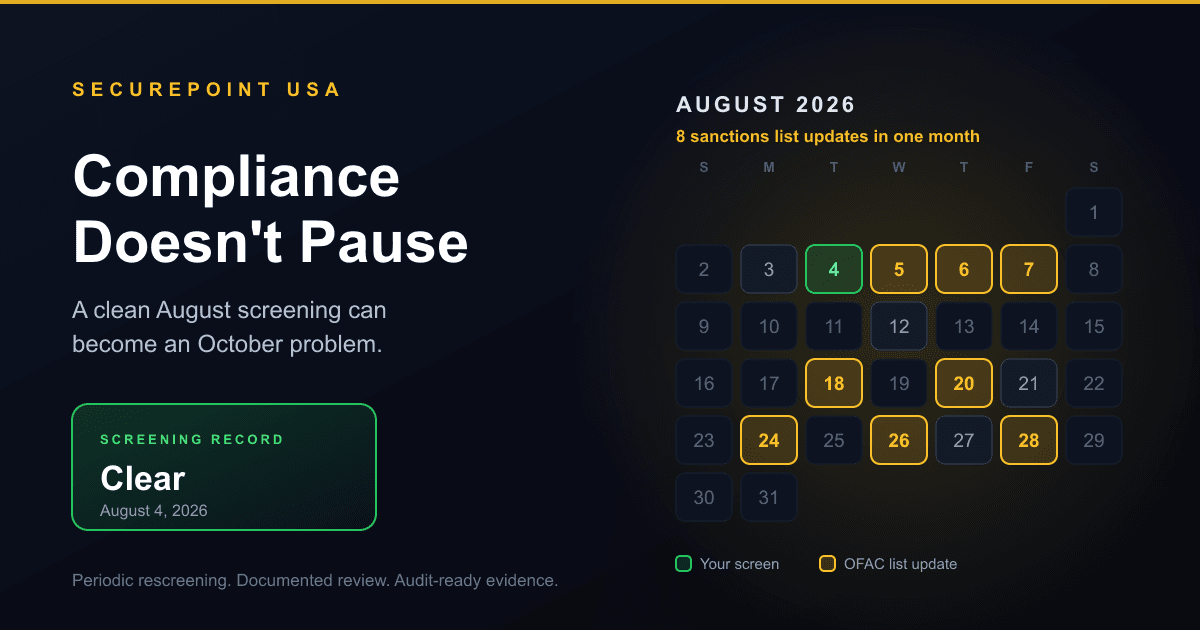
Sanctions lists change often. Don't just screen at enrollment. Scheduled re-screening checks payors again on a set interval, so a payor sanctioned after being cleared reaches your reviewer at the next re-screen.
The Compliance-Grade Standard
At SecurePoint USA, we didn't build a visitor management app. We built an Adjudication Platform. Our Education Module was built to close the "defensibility gap": the missing record of who was screened, who decided, and when.
We treat school screening with the same rigor we use for defense contractors. Every screening decision is written to an append-only, tamper-evident audit log, and every visitor check-in is recorded.
Built for K-12 and Higher-Ed
Cyber-threats are evolving from broad attacks to targeted child-PII harvesting. Is your visitor system a firewall, or a target? SecurePoint USA gives you a record of who was screened, who decided, and when.
Protect Your Institution
- Automated Student/Payor Screening
- OFAC & SDN Sanctions checks
- Audit-Ready Evidence Packs
Or get it sent to your inbox
Security is not a sales pitch. It is a promise to the next generation.