Skip to content

Blog

The OFAC 50% Rule Decoded for Operations

How aggregated ownership screening protects high-security facilities from inadvertent violations, and how to implement it without slowing operations.

Updated 5 min readBy SecurePoint USA

Rule Postponed

Update

November 10, 2025

BIS Affiliates Rule Postponed: BIS paused the 50% rule for one year after the Trump–Xi summit. The BIS Affiliates Rule is suspended through January 10, 2027 and is scheduled to take effect January 11, 2027 absent further BIS action (BIS final rule, FR 2025-19846, extended by FR 2026-22793, staying the interim final rule at 90 FR 47201). While the stay holds it is not operative under the EAR. Confirm the current status at bis.gov.

By default, SecurePoint USA calculates OFAC 50% ownership in shadow mode: the result is recorded but does not change the screening decision. SecurePoint screens names against the BIS Entity List, MEU List and Denied Persons List on every date. A strong possible match is blocked pending review, and a weaker one can be held for documented human review. A reviewer then confirms or rules out the match, and a denial is a separate recorded compliance decision. It does not yet calculate Affiliates Rule ownership, and it does not start blocking automatically when a scheduled date arrives.

Affiliates Rule Paused

BIS stayed the Affiliates Rule for one year starting November 10, 2025 after the U.S.–China trade summit.

Scheduled Return

The Affiliates Rule is scheduled to resume on January 11, 2027 absent further BIS action; use the pause to harden ownership workflows.

Ownership Screening Still Critical

A stay does not make ownership diligence optional. OFAC’s 50% Rule is in force today. The EAR’s General Prohibition 10, which bars proceeding with a transaction when you know or have reason to know a violation has occurred or is about to occur, and its Know Your Customer red-flag duties apply now, independent of the Affiliates Rule.

Previous Alert

Original BIS 50% Rule (Effective Sept 30)

BIS aligned with OFAC’s long-standing 50% rule, applying Entity List and MEU List restrictions to majority-owned foreign affiliates. A temporary general license (TGL) through November 28, 2025 was meant to give companies time to map ownership, shore up controls, and seek required licenses. BIS stayed the rule on November 10, 2025, before that license expired.

50% Aggregate Ownership

Any entity 50%+ owned (directly or indirectly) by Entity List or MEU List parties inherits their restrictions.

Temporary General License

A 60-day TGL (through Nov 28, 2025) lets exporters assess affiliates, gather attestations, and file licenses.

Red Flag 29

The rule added Red Flag 29 to the EAR's Know Your Customer guidance: an exporter that knows a party has an Entity List or MEU List owner must determine the ownership percentage or, if it cannot, obtain any license required for that owner unless a license exception applies. BIS stayed it with the rest of the rule, through January 10, 2027.

What is the 50% Rule?

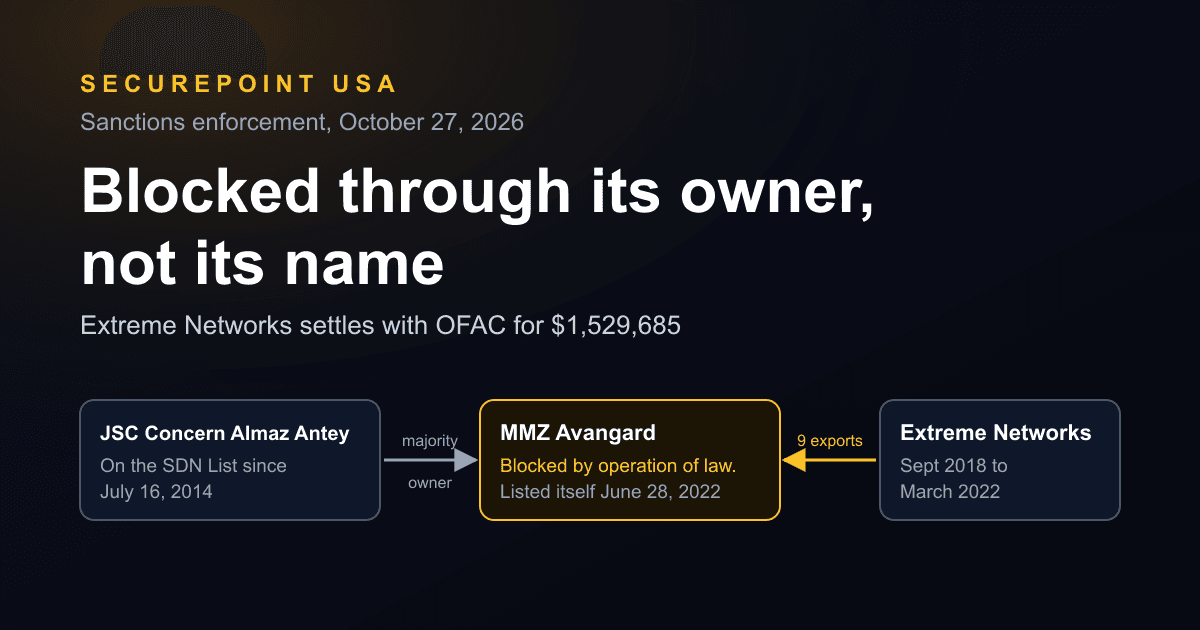
OFAC's 50 Percent Rule treats any entity owned 50% or more by one or more Specially Designated Nationals as blocked, even if the entity isn't listed. BIS extends the same logic to Entity List and MEU List ownership (stayed through January 10, 2027).

"If Person A (blocked) owns 30% and Person B (blocked) owns 25%, the entity is 55% blocked and must be treated as sanctioned."

This post covers putting the rule into practice. For the rule itself, including how OFAC adds up ownership, read the OFAC 50% Rule guide.

Sanctions screening engine

What Screening Must Capture

Three non-negotiable requirements for compliance

Aggregate Ownership Detection

Spot when multiple listed parties collectively cross 50%, even if no single owner holds a majority.

Deep Ownership Chains

Trace multi-hop subsidiaries and shell structures that inherit SDN blocked status, and Entity List or MEU status if the stayed Affiliates Rule takes effect.

Append-Only Audit Trail

Document every ownership lookup, escalation, and license decision for a BIS review.

SecurePoint USA

Intelligent Screening Architecture

Built for high-security environments where speed and accuracy must coexist.

Ownership Look-Through

Where ownership records exist, calculate whether blocked persons own 50% or more of a vendor. Results run in shadow mode by default.

Intelligent Adjudication

Decision-makers see applied thresholds, diagrams, and evidence without leaving the queue.

List coverage

Screen against the BIS Entity List. Denied Persons List screening is available when enabled. There is no buyer-facing Entity List versus MEU toggle.

Scheduled re-screening

Workforce and vendor re-screens run on a daily schedule against the lists you run. Ownership-change monitoring is not a live scheduled control.

Operational Playbook

Four steps to put the 50% Rule into practice

01

Entity Capture

Implement at check-in

Capture visitor and company legal names at check-in or vendor onboarding.

02

Ownership Verification

Policy-based triggers

Request attestations or registry docs for high-risk affiliates; map at least two ownership layers.

03

Compliance Escalation

Automated workflow

Escalate unresolved ownership questions and Know Your Customer red flags for license evaluation or hold decisions.

04

Audit Documentation

One-click export

Generate evidence packs from visit, screening, and decision records.

Why This Matters for Your Facility

Regulatory violations carry severe penalties: civil penalties under IEEPA (50 U.S.C. 1705) are inflation-adjusted and can also be twice the transaction amount. Criminal exposure and loss of facility access can follow.

Reputational damage compounds: failed audits can trigger contract reviews, clearance investigations, and stakeholder scrutiny.

Operational efficiency matters: SecurePoint USA runs OFAC 50% ownership lookups where ownership records exist, recorded in shadow mode by default, and sends BIS list matches to a reviewer. It does not calculate the BIS Affiliates Rule.

Screen visitors, review matches, and keep the record.

Ready to Streamline Your Screening?

Schedule a demo to see how SecurePoint USA traces ownership for the entities you screen through the screening API.

Readiness checklist while the BIS Affiliates Rule is paused

A short checklist to keep visitor and vendor screening evidence in order while the Affiliates Rule stay remains in effect.

  • Extend screening beyond CSL hits to include ownership graphs and parent lookups.
  • Increase re-screen cadence; even 1% changes can push a subsidiary past the 50% threshold.
  • Update SOPs and LMS modules to reflect the Affiliates Rule's current status.
  • Refresh contract clauses with licensing/termination language ahead of the Affiliates Rule's scheduled date.
  • Document escalation paths for Entity/MEU overlaps and unresolved Know Your Customer red flags.

Key Takeaways

  • The OFAC 50% Rule treats entities 50%+ owned by Specially Designated Nationals as blocked, even if not directly listed.
  • BIS Affiliates Rule is stayed through January 10, 2027, with reimposition scheduled for January 11, 2027. Treat that date as scheduled, not guaranteed, and confirm the current status at bis.gov.
  • Aggregate ownership detection must identify when multiple listed parties collectively cross 50%, even if no single owner holds a majority.
  • Append-only audit trails are essential for documenting ownership lookups, escalations, and license decisions to survive BIS audits.
  • SecurePoint USA can traverse ownership chains where ownership records exist. OFAC 50% results run in shadow mode by default: they are stored in screening metadata and do not change the access decision unless an organization turns enforcement on. BIS list matches go to a reviewer; SecurePoint does not calculate BIS Affiliates Rule ownership.

Found this helpful? Share it with a colleague.

Visitor Compliance Planning Checklist

  • Steps before the visit, at arrival and after the visit
  • Approvals, escorts and who reviews possible matches
  • Record-specific retention (22 CFR 122.5, 31 CFR 501.601)
Download PDF

Stay ahead of compliance changes

Get occasional notes on sanctions, export controls, and visitor compliance when we publish them.

No spam. Unsubscribe anytime.