Controlled Data Delivery
A governed workflow for controlled technical-data release.
Controlled Data Delivery replaces the SharePoint, email, and ad hoc secure-transfer shuffle with a defensible operating record: request, item-level classification readiness, in-product approval, sealed packaging with manifest hash, secure-portal pickup proof, and a complete evidence pack on delivery.
Real product views
The live workflow, queue, and sealed package proof are visible in product.
These screenshots come from the live SecurePoint Trade workspace using sanitized demo data. They show the delivery list, the request detail, and the package proof that sits behind the release trail.
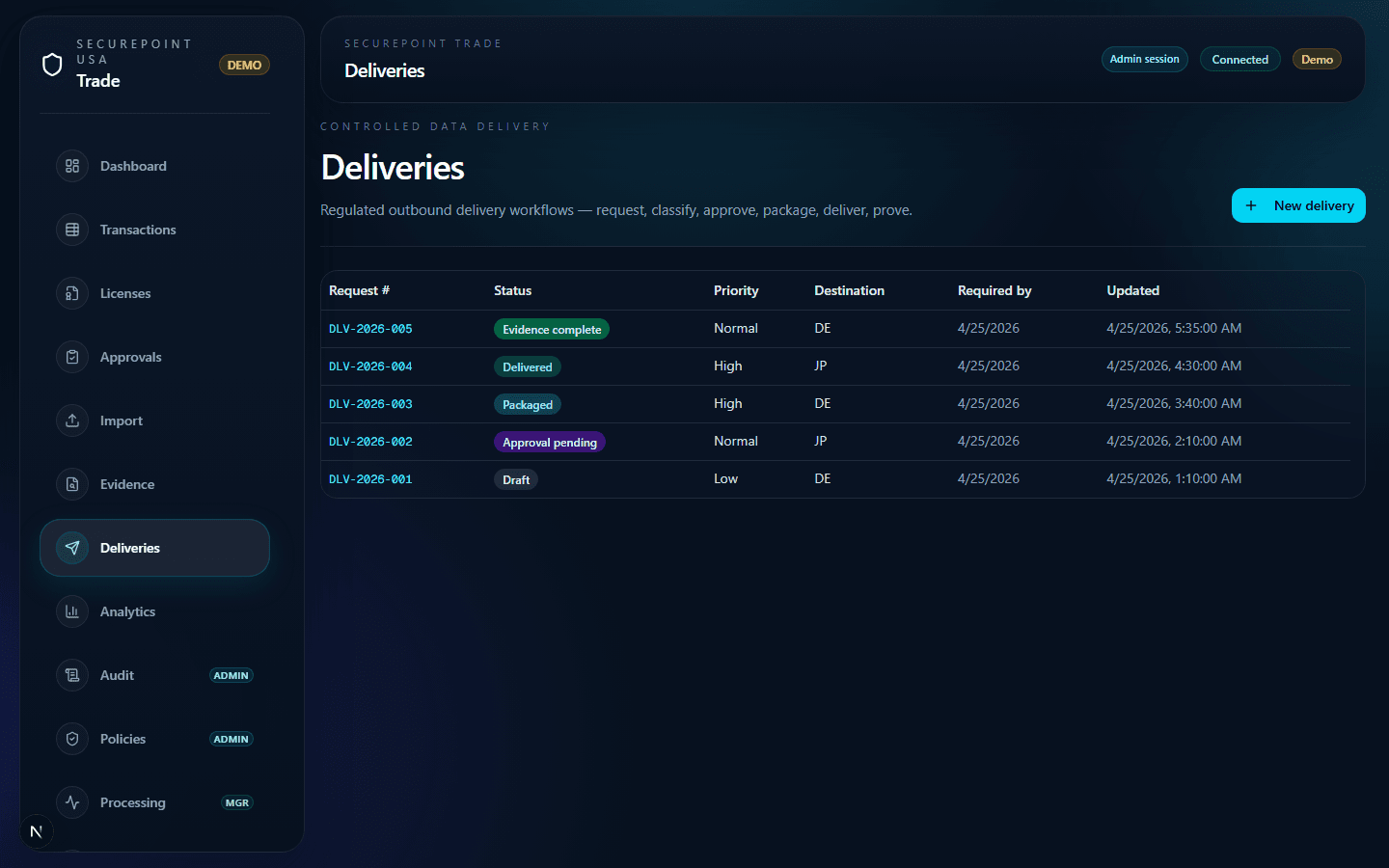
Delivery list
Controlled Data Delivery / Deliveries
The queue shows five requests with different statuses, so buyers can see the workflow depth at a glance.
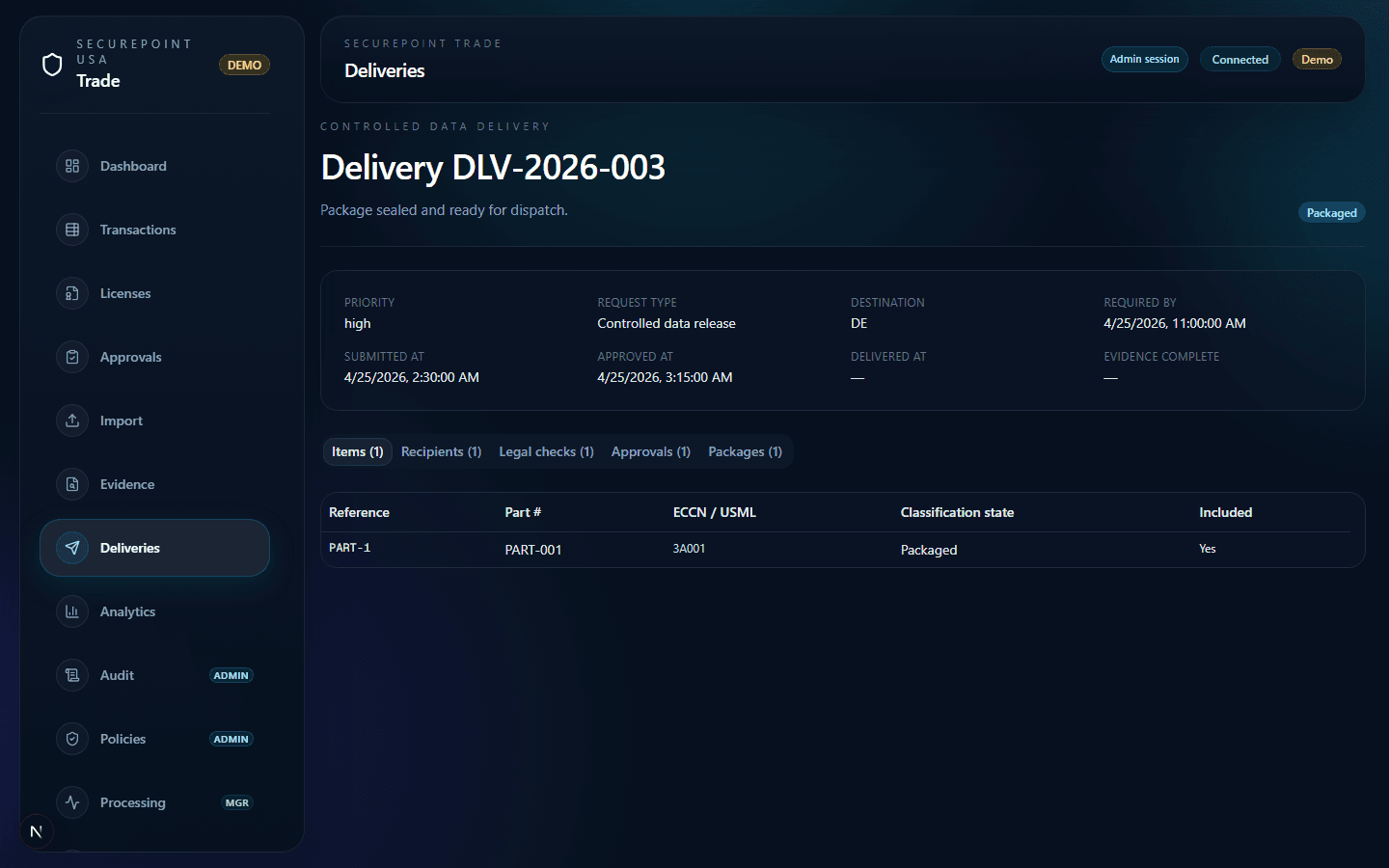
Delivery detail
Request detail with all five tabs
The request view carries the workflow header, metadata grid, and tab counts for items, recipients, legal checks, approvals, and packages.
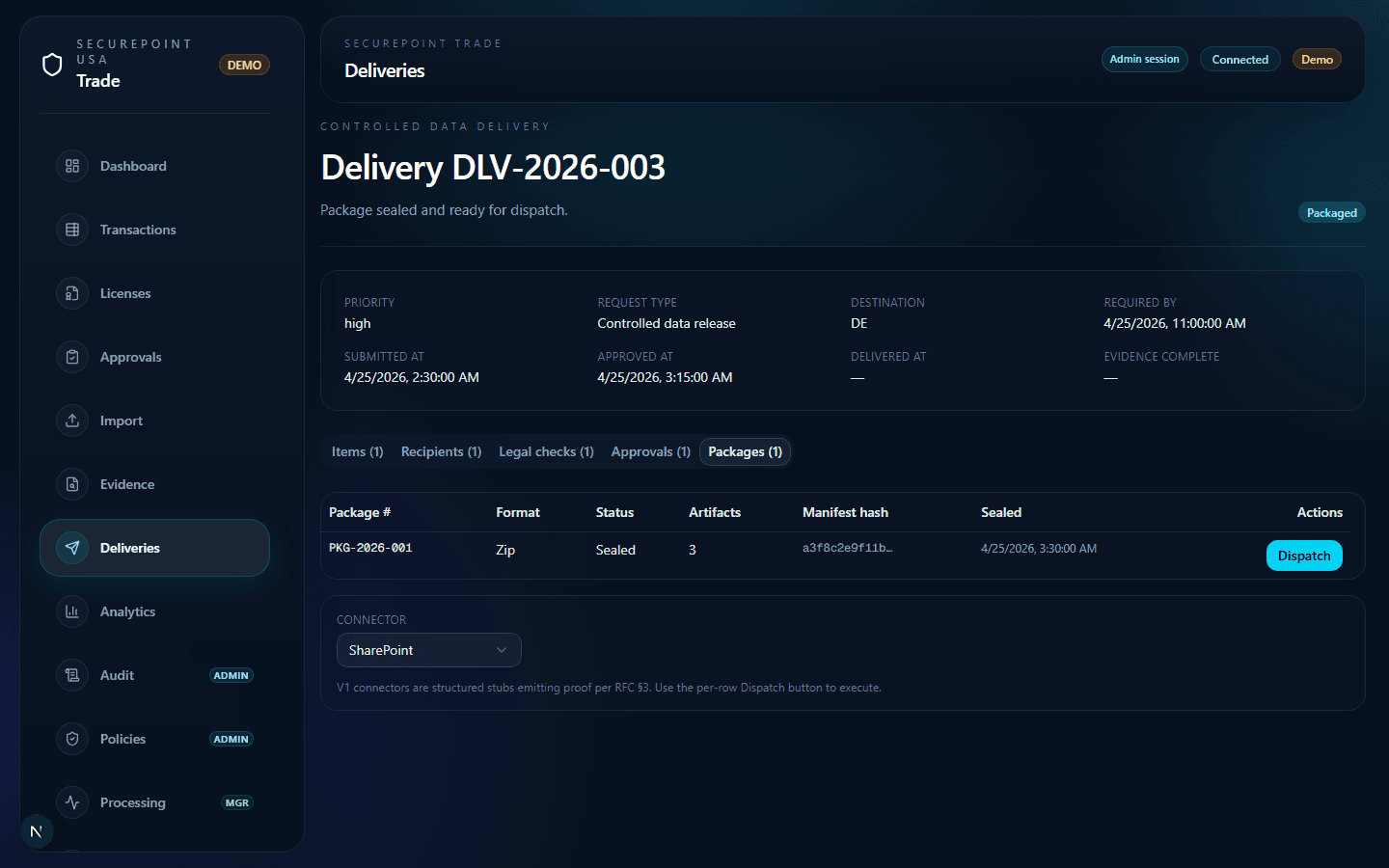
Package proof
Sealed package ready to dispatch
The package row keeps the manifest hash, checksum, sealed timestamp, and dispatch action in one frame.
Direct answer
What is controlled data delivery?
Controlled data delivery is the process of approving and releasing controlled technical data through a documented request, review, packaging, dispatch, and proof workflow rather than through ad hoc file sharing. It gives export-compliance, legal, and program teams a defensible record of who requested the data, who approved it, what was sent, how delivery was proven, and how the evidence is retained.
Digital delivery is still controlled trade
The control point is access, not whether the package is physical.
Controlled technical data can create exposure when it is released to the wrong recipient, destination, or channel. SecurePoint Trade helps govern the release decision before data leaves the team: approved recipient, approved destination, export classification, license or authorization basis, approved delivery channel, and an evidence trail that can be defended later.
Approved recipient
Each recipient is typed before approval - internal, external organization, regulator, foreign-person-review-required, or internal observer - with authorization basis and access country attached to the row.
Approved destination
Destination and access-country posture are part of the release decision, not notes buried after the file moves.
Classification and authorization
ECCN/USML, license linkage, exemption or no-license rationale, and legal checks stay attached to the request.
Approved delivery channel
The release happens through a governed channel with proof, not through unmanaged file sharing or email attachments.
Sealed package
Package manifest hashes and checksums make the delivered contents explainable and tamper-evident.
Evidence trail
Request history, approvals, connector proof, and artifact access events are retained without exposing signed URLs.
Why aerospace and defense teams need this
The real risk is the release trail, not the release.
During audit or enforcement review, teams are rarely faulted for releasing the data. They are faulted because the release happened outside a governed workflow and cannot be defended cleanly.
Unmanaged file sharing and ad hoc transfer
Controlled drawings and technical packages move through personal cloud folders, email attachments, and whatever transfer path was nearest. During audit, the absence of a governed release trail is the risk.
Classification happens out of band
The export-control check for the data release lives in an email thread or a Word doc, often rediscovered weeks later when the release is already out the door.
Approvals get attached to the wrong record
Legal and program approvers sign off in one system; the file moves through another. The approval and the release cannot be reconciled.
No proof of delivery
When questioned, the team can describe what was sent but cannot defensibly show how, when, and to whom, or that the release followed the approved path.
Six-step workflow
Request - classify - approve - package - deliver - prove.
Every transition is enforced by a database trigger, audited as a structured event, and tied to the same evidence pack the team can hand to a regulator.
Step 01
Request
Capture what data is being requested, by whom, and for which program or transaction context.
Step 02
Classify & check
Evaluate export-control posture, recipient eligibility, and data readiness before a file ever leaves the team.
Step 03
Approve
Route the release through the right legal, compliance, or program approvers with a documented rationale.
Step 04
Package
Assemble the delivery package against the approval, with classification and recipient metadata attached.
Step 05
Deliver
Log the controlled handoff through the approved channel so there is no ambiguity about how the data moved.
Step 06
Prove
Retain proof of request, approval, package, and delivery so the release can be defended during review or audit.
Core capabilities
Everything a serious release-control team asks for is built into the workflow.
Delivery requests with item-level readiness
Capture recipients, included items, ECCN/USML, license or authorization basis, and per-item classification state. A request cannot enter approval until every included item is ready.
Recipient typing and authorization basis
Each recipient carries a typed role - internal, external organization, regulator, foreign-person-review-required, or internal observer - alongside authorization basis, approved delivery channel, access country, and destination and channel policy codes.
Consolidated readiness summary
A single readiness gate evaluates recipient, destination, classification, license or authorization, package, and approved-channel checks before approval and again before dispatch. Blockers surface in-product with the responsible field attached.
Recipient and destination checks
Record destination, recipient, item-level, and package-level legal checks. The request cannot exit legal review until the required checks are passed or waived with rationale.
Admin and manager approval enforcement
Approval decisions stay restricted to the right reviewers, keeping the release path fail-closed for the program.
Sealed packages with manifest hash
Each package is sealed with a deterministic manifest hash and an aggregate checksum. Manifests are reproducible across runs, and tampering is detectable.
Operator artifact attachment
Operators attach package artifacts through short-lived signed upload URLs into private storage scoped by organization, delivery, and package. Finalize verifies the object exists before recording the artifact, and audit metadata never carries signed URLs or raw storage paths.
Approved-channel dispatch with proof
Approved delivery channels emit a structured proof payload: connector type, transfer ID, sent-at, delivery status, receipt status, and retry flag.
Evidence pack on completion
On delivery, generate a complete evidence bundle: workflow event ledger, sealed package metadata, artifact references, and connector proof.
Deployment notes
Built for production rollout, configured per program.
Controlled Data Delivery is in a controlled pilot as part of Trade. Core request, approval, packaging, secure-portal pickup proof, and evidence handling are standard; additional connector endpoints, role assignments, and destination policies are configured during deployment.
Included out of the box
- - Request intake with item readiness, recipients, legal checks, approvals, packages, and evidence pack generation
- - Recipient typing with authorization basis, approved delivery channel, access country, and destination and channel policy codes
- - Consolidated readiness summary panel surfacing recipient, destination, classification, license, package, and approved-channel blockers
- - Operator artifact attachment to draft and assembling packages through signed upload URLs into private, namespace-scoped storage
- - /deliveries UI with list, draft, detail, and package views
- - Secure-portal pickup proof today; SharePoint, Cryptshare, SFTP, and FAA SharePoint are planned connectors on the integration roadmap
- - Delivery events written to the audit log with structured object references and no signed URLs in audit metadata
Configured during rollout
- - Connector endpoints and credentials are configured per program
- - Destination templates and recipient policies are set during rollout
- - Role mapping follows the customer approval chain
- - Retention and evidence handoff follow the program's compliance rules
FAQ
Controlled Data Delivery frequently asked
Direct guidance for teams evaluating governed technical-data release workflows.
See controlled-release inside SecurePoint Trade.
Walk through request, item readiness, approval, sealed packaging, dispatch, and evidence pack with a delivery engineer.